
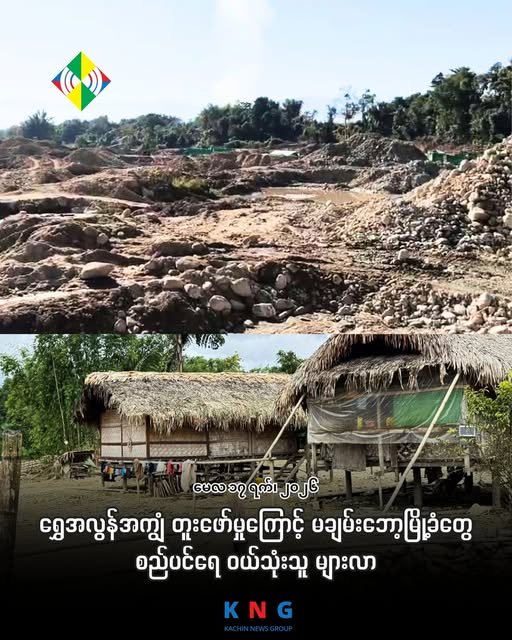
In Machanbaw Town in Putao District, Kachin State, excessive gold mining has led to a shortage of natural drinking water sources, forcing a growing number of residents to rely on fee-based municipal water supplies.
A resident of Machanbaw told KNG that the Mali Kha River, traditionally relied upon by locals for drinking water, has become polluted due to excessive gold mining that has rapidly expanded since the coup, forcing many residents to purchase municipal water.
“Previously, town residents received piped water sourced from the Mali Kha River, and only a small number of people purchased municipal water. However, over the past two years, the number of residents relying on paid municipal water has increased significantly. Due to gold mining activities, the river water has become heavily polluted and is no longer safe for drinking,” he said.
Until late 2023, Machanbaw residents relied on the Mali Kha River for drinking water. However, since then, intensive gold mining using heavy machinery upstream has damaged the river’s water quality, forcing residents to rely on paid municipal water supplies.
“Municipal water supply is fairly reliable, and it can be delivered directly to our homes. However, the cost is often higher than electricity bills. With more people now using it and demand increasing, water prices are also rising,” the source added.
Locals reported that as the number of users has increased, municipal water bills have also risen slightly.
“As more people have started using municipal water, the cost has also gone up. What used to be around 2,000 to 3,000 MMK per month has now increased to about 4,000 MMK on average, and in some months, it can reach as high as 6,000 MMK,” said a woman from the town.
Machanbaw, located along the Mali Kha River, has hard underlying rock that makes it difficult to drill and access groundwater. As a result, when river water cannot be used, locals have had to rely on municipal water supplies.
“It’s almost impossible to dig a well because of the solid rock underground. Some people have tried, but the wells dry up during the summer. Even when a well can be dug, it doesn’t provide water year-round, so most people have stopped trying. As a result, residents now rely on municipal water when river water is not usable,” another Machanbaw resident explained.
Putao District has traditionally seen small-scale gold mining, but since the 2021 coup, it has expanded into large-scale operations using heavy machinery. In the Mali Kha River, extensive mining activity began along both the upper and lower sections as well as on both riverbanks in late 2023.
In the five years since the coup, gold mining has expanded dramatically in villages such as Longshayang, Mulashidi, Phetma, Nawnghkaing, Sankawng, and Namhkam in Putao Township, as well as along the Mali Kha River in Machanbaw Township. Large-scale mining has also been observed in Sumprabum Township.
Excessive gold mining has caused some small rivers and streams that naturally flow through villages and farmland to vanish completely.