
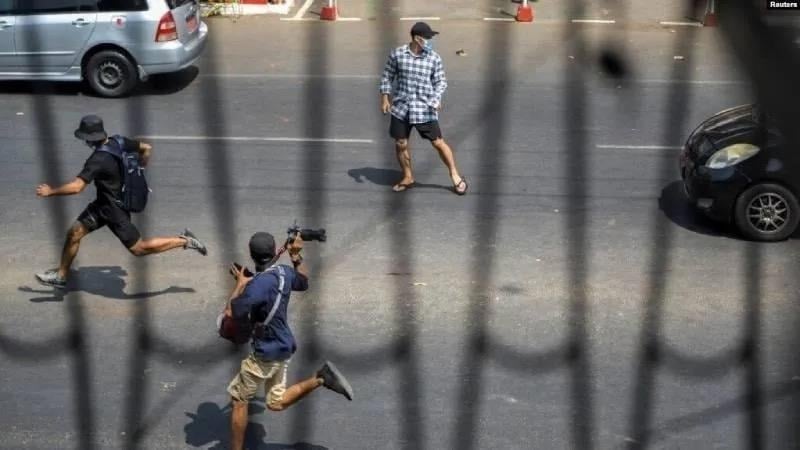
The military junta’s Ministry of Information officially revoked the publishing licenses of Myaelatt Athan, Red News Agency (RNA), and Asia Citizens News Agency on 11 May.
The regime accused the outlets of violating Section 8(b) of the Printing and Publishing Law, a common legal tool used by the administration to silence independent reporting.
Editors-in-chief from the targeted organizations expressed little surprise at the decision, with some describing the formal rejection as a “silver lining.”
Ye Thwin Hein, editor-in-chief of Myaelatt Athan, noted that being publicly targeted by the military helps clarify their independence to critics who have occasionally accused the outlet of pro-junta bias when reporting on human rights abuses within revolutionary groups.
Similarly, Win Zaw Naing of Red News Agency emphasized that while the loss of licenses is expected under a dictatorship, the real casualty is the public’s access to impartial information.
“If press freedom no longer exists in Myanmar, the greatest loss will be the absence of independent and impartial media that serve the public interest. This is a pattern seen in every dictatorship. That is why journalists must continue striving to defend the rights of the people,” he said.
Ko Ko Zaw, chairman of the Independent Press Council of Myanmar (IPCM), criticized the junta’s latest actions, saying that despite changes in name and structure since the coup, its methods and conduct remain unchanged.
“They may have changed their appearance, but they are still acting the same way they did after the coup. Aside from Senior General Min Aung Hlaing now being referred to as U Min Aung Hlaing, I see no real change in how they operate,” said IPCM Chairman Ko Ko Zaw.
Since the coup, the military junta has revoked the publishing licences of more than 20 independent news outlets, including Mizzima, Democratic Voice of Burma (DVB), Khit Thit Media, Myanmar Now, and 7Day News, while also arresting, imprisoning, and killing journalists, media workers said.
According to data from the Independent Press Council of Myanmar (IPCM), more than 200 journalists were arrested between the 2021 military coup and May 2026, with 18 still remaining in prison.
According to Reporters Without Borders (RSF), Myanmar ranks 166th out of 180 countries in the World Press Freedom Index, placing it in the “red zone” as one of the most dangerous environments for press freedom.