
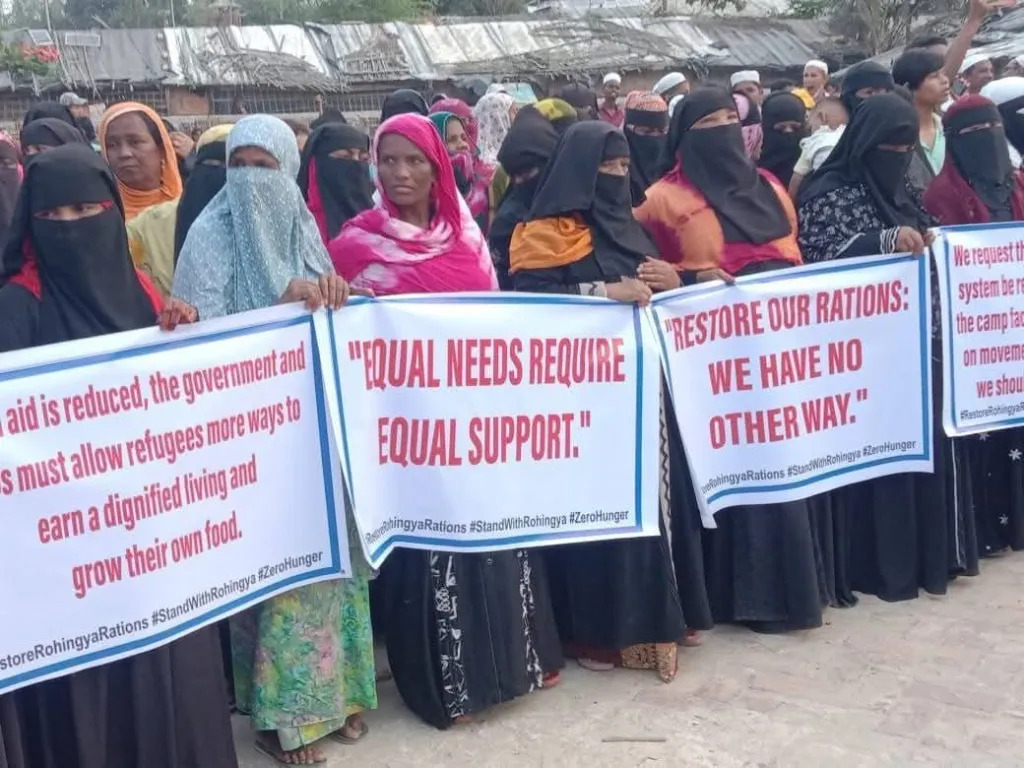
Hundreds of Rohingya refugees staged a peaceful protest in Camp 24 LMS in Cox’s Bazar on March 31, voicing alarm over proposed reductions in food assistance and a controversial aid categorization system that could redefine access to humanitarian support.
Core Developments
According to protest participants, families gathered inside the camp to oppose planned cuts to food rations—widely regarded as the primary lifeline for over one million Rohingya refugees living in Bangladesh.
Refugees warned that any reduction in assistance would disproportionately affect the most vulnerable, including children, elderly individuals, and female-headed households. With strict movement restrictions and limited livelihood opportunities, most families remain entirely dependent on humanitarian aid.
Community members also rejected a proposed classification system intended to categorize refugees based on vulnerability levels. Protesters argued that such distinctions fail to reflect the uniform hardship experienced across camps.
“We all suffer the same conditions here. Dividing us will only create conflict,” one participant said.
Many expressed concern that categorization could result in unequal food distribution and deepen internal divisions within an already fragile refugee community.
Aid Policy Shift and Structural Pressures
The proposed changes come amid growing funding constraints faced by international agencies such as World Food Programme and UNHCR, which have repeatedly warned of resource shortfalls affecting Rohingya operations in Bangladesh.
Humanitarian actors have increasingly explored targeted aid models—prioritizing the “most vulnerable”—as global crises divert donor attention and funding.
However, critics argue that such approaches may be ill-suited to the Rohingya context, where structural deprivation—legal, economic, and geographic—affects nearly all refugees equally.
Geopolitical Context: Bangladesh–Myanmar Tensions
The protest underscores broader regional dynamics shaping the Rohingya crisis. Bangladesh continues to host over a million refugees with limited international burden-sharing, while repatriation efforts remain stalled due to instability in Myanmar’s Rakhine State.
The rise of the Arakan Army (AA), now a dominant non-state actor in parts of Rakhine, has further complicated prospects for safe return. Reports of militarization, recruitment pressures, and governance uncertainty raise serious concerns about conditions necessary for voluntary repatriation.
For Bangladesh, prolonged refugee presence creates mounting economic, environmental, and security pressures—factors that indirectly influence humanitarian policy decisions, including aid scaling and management.
Arakan Army (AA) Dynamics and Security Spillover Risks
Analysts note that deteriorating living conditions in the camps could intersect with evolving dynamics across the Naf River. Armed actors, including the Arakan Army (AA), have expanded their influence in northern Rakhine, raising concerns over:
Cross-border insecurity
Informal recruitment networks
Increased vulnerability of displaced populations
While no direct link has been established between the protest and armed group activities, worsening humanitarian conditions are widely recognized as a risk factor for instability.
Legal and UN Framework Considerations
Under international humanitarian principles, aid distribution must adhere to non-discrimination, impartiality, and needs-based allocation. However, implementation remains complex in protracted refugee settings like Cox’s Bazar.
The Rohingya—denied citizenship in Myanmar and classified as stateless—remain under the protection mandate of UN agencies, yet lack enforceable legal guarantees ensuring long-term rights.
Observers warn that reducing food assistance without viable alternatives could raise concerns under international human rights standards, particularly regarding the right to adequate food and dignity.
Community Response and Call for Dialogue
Despite strong opposition to the proposed measures, protest participants emphasized their willingness to engage constructively with authorities and humanitarian agencies.
Refugee leaders called for:
Equal food distribution across all households
Transparent consultation processes
Policies reflecting ground realities rather than administrative classifications
“We are not rejecting cooperation,” one community member said. “We are asking for fairness and survival.”
Conclusion
The Camp 24 LMS protest reflects a critical inflection point in the Rohingya humanitarian response. As funding shortages, geopolitical tensions, and evolving conflict dynamics reshape the crisis, decisions made today may carry long-term implications for stability—both inside the camps and across the Bangladesh–Myanmar frontier.