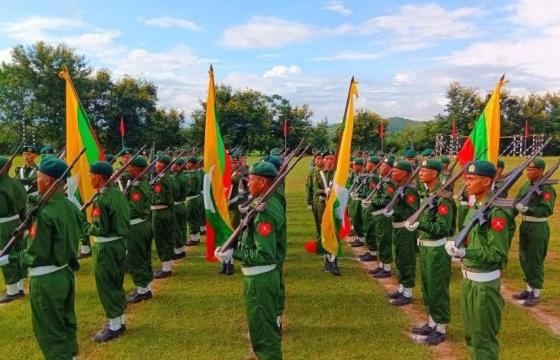

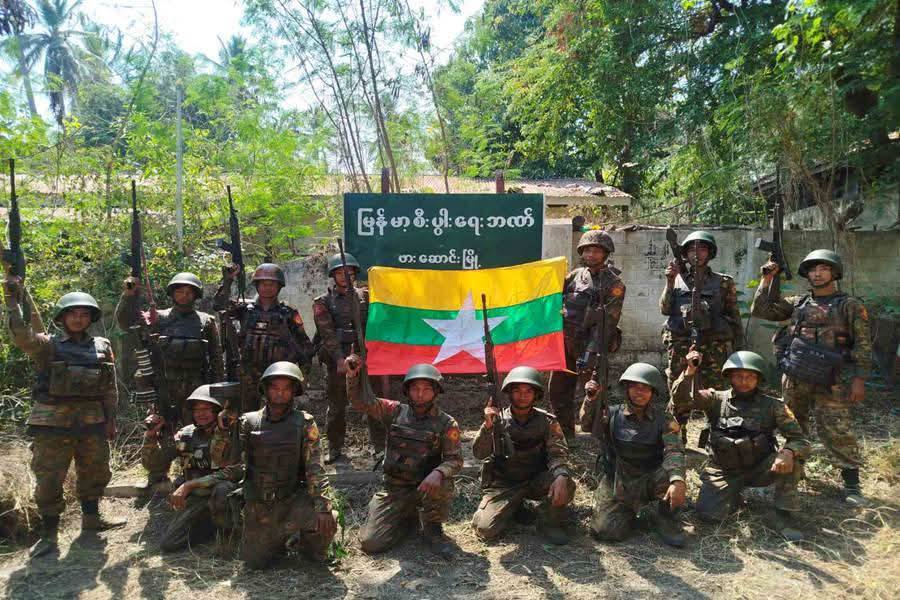
Junta-controlled state-owned newspapers claimed the junta regained control of some territories previously held by ethnic armed organizations (EAOs) and resistance forces in the third week of February.
After the election, the junta captured Banmauk Town in Sagaing Region and Hpasawng Town in Karenni State, following two separate four-month-long large-scale offensives.
Banmauk Town, previously jointly held by the Kachin Independence Army (KIA) and People's Defence Force (PDF), was recaptured by the junta and Shanni Nationalities Army (SNA) on February 6, following an operation that began in late September last year.
State media reported that Hpasawng Town, previously controlled by the Karenni resistance coalition, was retaken on February 15 during the junta’s Operation Yan Naing Min.
U Banyar, secretary of the Interim Executive Council of Karenni State (IEC), acknowledged that around 500 junta troops entered Hpasawng Town in mid-February. He urged the public to stay vigilant, warning that the military situation in the region remains tense, with fierce clashes possible at any moment and the threat of airstrikes looming.
“The junta was stronger than us in both military strength and technology. It had clear air superiority, dropping many bombs and using drones. Dealing with that was our biggest challenge. Strategically, in some situations, we really had no choice but to retreat. Airstrikes caused us the most trouble,” he told Than Lwin Times.
The junta lost more than 100 towns during the armed resistance that surged after the coup but recovered from these setbacks with political and military support from China. As a result, the junta retook Kawlin, Lashio, Hsihseng, Mobye (Mongpai), Naungcho (Nawnghkio), Thabeikkyin, Demoso, Kyaukme, Mogok, Momeik (Mongmit), Singu, Banmauk, and Hpasawng from the EAOs and resistance forces.
Captain Zin Yaw, a former junta officer who joined the Civil Disobedience Movement (CDM)—where civil servants and security personnel refuse to work for the regime—said the junta increasingly relies on firepower, favoring airstrikes and artillery bombardments over conventional ground offensives.
“The junta would first employ artillery and airstrikes to weaken the resistance, then send in ground troops. It has also been using drones more. We saw this on the Mogok front, and it was similar in Karenni. The junta’s big advantage is that it can keep replacing its losses through conscription. It receives around 5,000 new recruits every month, so casualties aren’t really a problem anymore, it can just absorb the losses,” he said.
On the resistance side, replenishing depleted manpower faced numerous obstacles. Consequently, when the junta launched heavy offensives, resisting at full strength was impossible, necessitating strategic retreats, he pointed out.
As a result, resistance forces are losing towns they once controlled. Although they can rely on donor funds for financial and technical support, they lack the junta's ability to replenish manpower, Captain Zin Yaw noted.
‘Operation 1027,’ a major military initiative jointly launched by the Three Brotherhood Alliance, dealt a significant blow to the junta. In response, the junta enforced the conscription law, drafting tens of thousands of new recruits, and used this manpower to regain lost territories.
Coup leader Senior General Min Aung Hlaing has claimed at least twice this month that the junta will collaborate with supportive members of the public to effectively crush armed insurgencies.
The resistance-run National Unity Government (NUG) and the K3C resistance coalition—formed through collaboration among the KIA, the Karen National Union (KNU), the Karenni National Progressive Party (KNPP), and the Chin National Front (CNF)—are working to establish a new collective leadership framework to advance their revolutionary goals.