
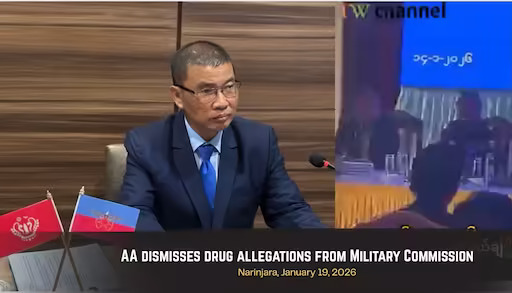
Khaing Lu Hla (Roma Mray) — On the morning of January 14, the Military Commission held a press conference concerning drugs in Pyin Oo Lwin, Mandalay Region.
At the press conference, it was revealed that a large quantity of drugs and substances used to produce drugs had been confiscated, in addition to equipment utilized for online gambling.
Maj. Gen. Zaw Min Tun, who leads the press office of the National Defense and Security Council and serves as the Deputy Minister of Information, has alleged that the AA is engaged in drug-related activities alongside other ethnic revolutionary groups, similar to accusations made in the past.
In response to these allegations, U Khaing Thukha, the spokesperson for the AA, denied the accusations, asserting that the actual owners of the drug factory were the generals of the Military Commission, who are part of the current military government.
He stated, "The recent capture of the drug manufacturing facility is a contrived event. The actual owners of this drug facility are the generals of the military commission associated with terrorism and fascism. Rather than revealing the actual offenders, they are exploiting this scenario to undermine and focus on their primary opponents, the revolutionary factions. This is a clear example of fabrication."
U Khaing Thukha rejected the claims that the temporary buildings and materials for drug production in Mong Ya Township, Shan State, were linked to the revolutionary forces, describing the accusations as baseless.
He stated, "This issue has no association with us. It is merely an unfounded and fabricated accusation. These factories have been operating for many years, and the military council is fully aware of their existence. They are involved because their interests coincide with these activities, and they have received protection from previous Burmese military governments. Zaw Min Htun himself acknowledged at a press conference that the arrests were made at the behest of the Chinese authorities.
General Zaw Min Htun accused EAO groups of being involved in drug-related activities, claiming that these groups are undermining the stability of the nation and using drug production and distribution as a source of revenue. He mentioned examples of AA's participation in drug trafficking and distribution, asserting that most of the seized drugs in different regions were connected to AA.
Zaw Min Tun detailed the drug trafficking routes, noting that they primarily originate from the Hsipaw and Mong Yar areas. These routes reach Malaysia and Bangladesh by sea, with the involvement of AA resulting in several arrests. Additional paths lead from Loikaw and Taungoo into Thailand, linked to the KNU/KNLA, NUG, and PDF revolutionary organizations.