
As hearings continue at the International Court of Justice (ICJ) in The Hague, the legal strategy deployed by Myanmar’s military council is drawing growing criticism—not only for its substance, but for what many observers describe as a striking absence of humanity.
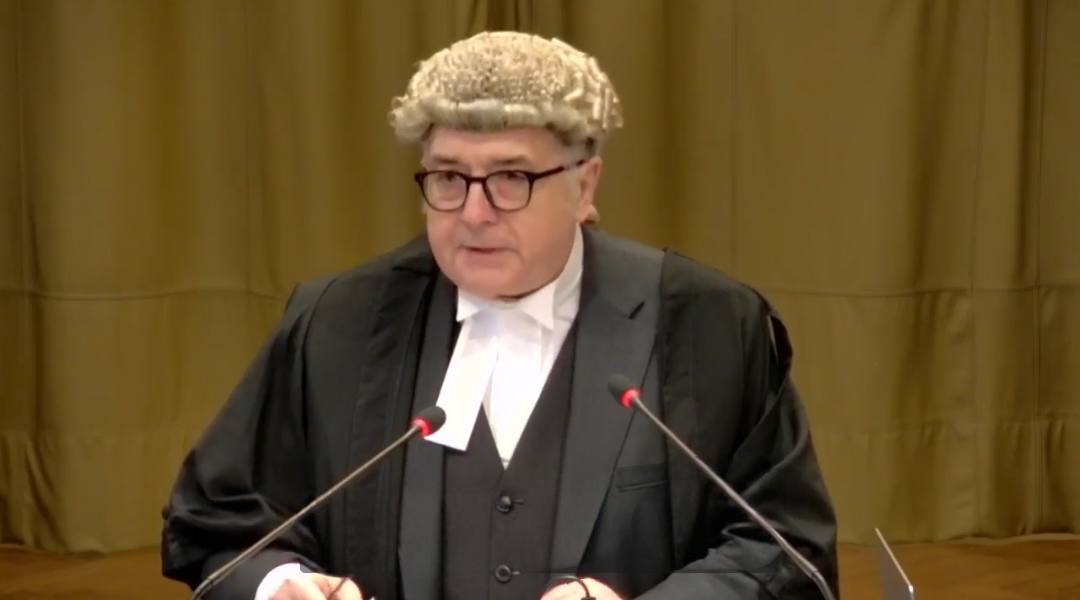
Representing the military council , international lawyer Christopher Staker has repeatedly emphasized that the case brought by The Gambia is not a criminal trial and does not seek to determine individual guilt. Instead, he has framed the proceedings narrowly as a question of state responsibility, arguing that the legal threshold for proving genocide under international law is exceptionally high.
From a purely technical standpoint, this argument is not new. Genocide is, by design, one of the most difficult crimes to prove in international law. However, critics argue that the junta’s reliance on procedural and definitional barriers risks reducing one of the gravest human tragedies of the 21st century to an abstract legal exercise.
Human rights groups contend that such a defense deliberately sidesteps the reality of what occurred in northern Arakan State during the 2016–2017 military operations. Entire villages were burned, thousands of civilians were killed, and more than 700,000 Rohingya were forced to flee to neighboring Bangladesh. For many observers, any legal argument that fails to engage meaningfully with these facts appears morally hollow.
Particularly controversial was Staker’s claim that The Gambia is not a directly affected party and that its interpretation of the Genocide Convention is subjective. Legal analysts note that this position challenges the very foundation of the convention, which was designed to impose obligations on all states to prevent and punish genocide, regardless of where it occurs. If accepted, such reasoning could significantly weaken the international legal framework intended to prevent mass atrocities.
Equally troubling to critics is the military council’s continued portrayal of the violence in Arakan State as “clearance operations” or “counterterrorism campaigns.” While states have a right to address security concerns, human rights organizations argue that these labels cannot justify the scale of civilian harm documented by survivors, satellite imagery, and independent investigations.
The military council’s rejection of reports by the UN Fact-Finding Mission (FFM) has also come under scrutiny. Myanmar previously denied the mission access to the country, yet now dismisses its findings as biased. Observers view this as a contradictory stance that undermines the credibility of the junta’s defense rather than strengthening it.
Perhaps most revealing, analysts argue, is the continued avoidance of the term “Rohingya,” replaced instead with “Bengali.” This linguistic choice is widely seen as a political statement rather than a legal one, reflecting the junta’s longstanding refusal to recognize the Rohingya as an ethnic group. In the context of a genocide case, such denial carries significant symbolic weight.
Ultimately, the criticism directed at the military council’s ICJ defense goes beyond legal disagreements. At its core, the debate is about whether international justice can remain detached from human suffering. While the ICJ must, by necessity, operate within strict legal parameters, many argue that justice devoid of empathy risks losing its moral authority.
As the proceedings continue, the world is watching not only how the law is interpreted, but also whether international justice can confront atrocity with both legal rigor and human conscience. The court’s eventual decision will have implications far beyond Myanmar—shaping how genocide is understood, prosecuted, and prevented in the future.