
“I don’t believe voting will bring any change. Even now, it feels like we’re reliving the old authoritarian era. I feel afraid whenever I see powerful figures, especially those with high ranks and authority,” said a 27-year-old woman from Loikaw, speaking about the current voting situation.
She earns her living as a market vendor in Loikaw and said the election is far less important than daily survival. She expressed disbelief that a single vote of hers could overcome the ongoing conflicts or bring about any political change.
Even though the election date approaches, Karenni residents show little interest in the junta-organized election. While people in areas beyond the junta’s reach are very little interested in voting, residents living in junta-controlled areas like Loikaw are being forced to vote due to various pressures.
In Loikaw, many residents have lost all their property and homes due to the consequences of the war. They now struggle to survive by taking whatever work they can find.
Loikaw is the capital of Karenni State and a city where the junta’s administrative system continues to operate. Although junta departments maintain institutions such as universities, basic education schools, the central market, and landmark sites, residents said that there are increasingly strict security checks at city entry and exit points.
Many people who fled earlier fighting have begun returning to Loikaw. According to census data collected by the junta in areas under its control in March 2025, Loikaw Township has a population of over 20,000 people, specifically 23,848.
Public Attitudes Toward the Election in Loikaw
A 30-year-old woman from Loikaw, currently displaced in western Demoso, said she has not returned to Loikaw because she fears being forced to vote against her will and does not want to live under military rule.
“As an ordinary citizen, I don’t trust this election, and I won’t return to Loikaw to vote,” she said.
Although some political parties have been actively campaigning since last November, a male Loikaw resident said most locals have no interest in the election.
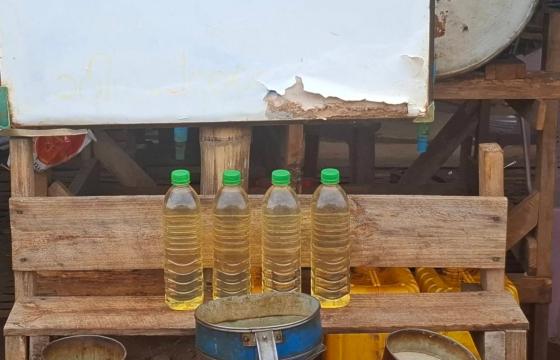
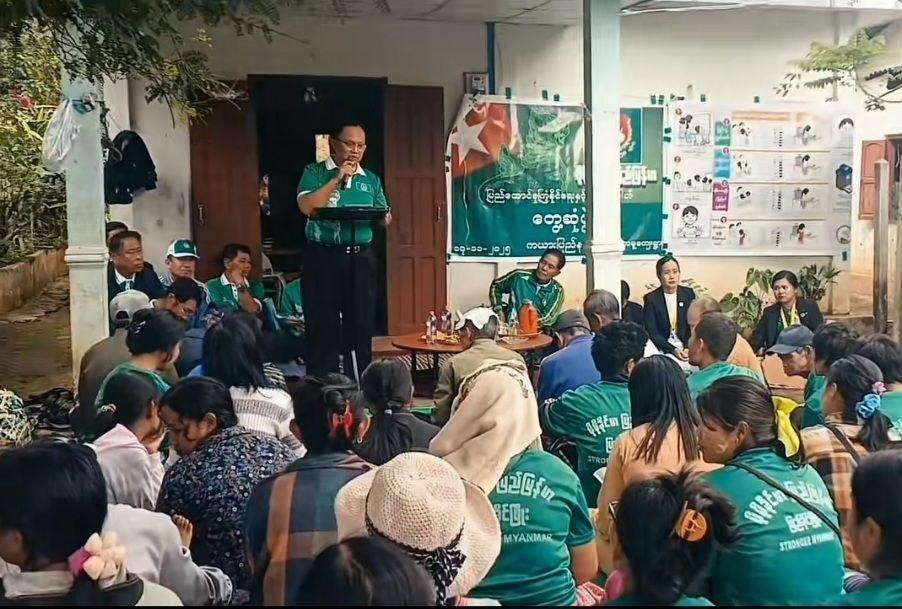
“They distribute rice, cooking oil, and clothes to those who attend. They hold talks at ward preschools, futsal courts, or under houses, places where gatherings are possible. The USDP seems to be the most active,” he said.
According to campaign photos, most attendees appear to be military affiliates, military families, and some civil servants, with attendance rarely exceeding 50 people. Participants said that rice, oil, and clothes were distributed by the Union Solidarity and Development Party (USDP) and the People’s Pioneer Party (PPP).
How Will the Junta Punish Non-Voters?
Although there have been no armed threats to force voting in junta-controlled urban areas, another resident said pressure is being applied through other means.
“No one dares not vote. They’re saying it could mean three years in prison. It doesn’t really matter which party you vote for,” the resident said.
He added that rumors are circulating that those who fail to vote on election day will be arrested under laws against obstructing or disrupting elections.
These threats are spreading among the public largely as rumors, but they create an atmosphere of fear.
Meanwhile, to prevent any disruption to the election, the junta arrested five people, including three minors, in September under Section 23(a) of the Law on Protecting Elections from Obstruction.
“The boys who were arrested got eight-year sentences. Money had to be bribed. If not, it could have been worse. They were dragged away. Those whose families paid weren’t sent to the military but were still imprisoned,” said someone close to the detainees.
Currently, residents of Loikaw are fear forced conscription under the People’s Military Service Law. They also feel unsafe discussing the election and are cautious in both their movements and speech.
How the Junta Seeks Votes from Non-Residents
Displaced people from other townships now living in Loikaw have also been included in voter lists. Those fleeing conflict from Hpasawng, Bawlakhe, Mawchi, and Shardaw are required to apply for temporary residence permits. As part of the process, they must fill out forms stating their willingness to vote.
“Everyone who comes back already has their name prepared for voting. New arrivals have their names and family details recorded, photos taken, and are immediately included in voter lists. Without applying for temporary residence, you can’t stay here,” said a displaced person from Hpasawng Township.
Conflict May Increase During the Election Period
Residents warn that human rights violations may increase during December, which is the election month. During this period, junta forces have carried out airstrikes on civilians in areas controlled by revolutionary forces.
On December 6, junta aircraft bombed a displacement camp in the Palong village tract of Loikaw Township. Similarly, on the night of December 7, three locations in western Demoso were bombed.
These areas were not active combat zones but displacement sites, and the attacks were carried out intentionally. The locations are adjacent to Loikaw Township.
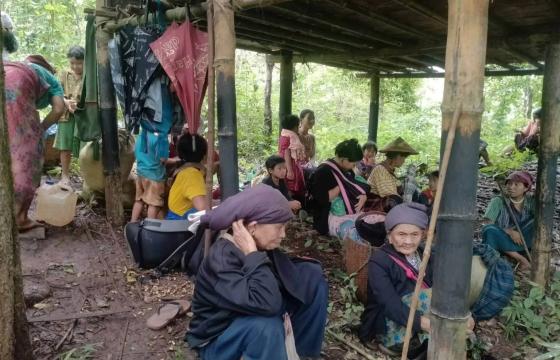
“Planes frequently bomb displacement areas. It’s not strange anymore. Of course, we’re afraid. But, we can only rely on bomb shelters,” said a woman from Demoso.
Additionally, Light Infantry Battalion (LIB) 102, based in Ngwe Taung, Demoso, has been firing heavy artillery daily, leaving residents in constant fear.
Election Conditions in Bawlakhe, the So-Called ‘Military City’
Bawlakhe, located south of Loikaw Township and locally known as a military town, remains under junta control. It is over 30 miles from Loikaw and had a population of 8,480 households (over 1,500 homes) according to the 2014 census.
Because Bawlakhe hosts military command units and numerous bases, it is primarily inhabited by military families, supporters, and government staff.
Due to fighting and disrupted supply routes, most Bawlakhe residents struggle for survival and have fled. Currently, only around 200 people remain in the town, mainly military families, affiliates, civil servants, and a few locals.
With only a few hundred people, Bawlakhe is included in Phase 1 of the election scheduled for December 28. Although the junta claims the election will be a “free and fair multi-party democracy,” a young woman from Bawlakhe described it as a political manoeuvre.
“Who is even left in Bawlakhe? Most people have fled the war. How are they supposed to vote? This is a setup. They are playing politics in a seemingly legitimate way,” she said.
A 40-year-old man added that although no fighting has ever occurred in the town itself, life under military control feels unsafe, which led him to choose displacement.
Calling such an election “representative of the people’s voice” is inaccurate, he said, adding that it is merely a show for international recognition.
No political parties are campaigning in Bawlakhe, and whether people vote or not, nothing will change for them, so the situation remains normal, according to locals.
Areas Where the Junta Plans to Hold Elections
The junta plans to hold elections in four of Karenni State’s townships, which are roughly half of the state. These include Loikaw and Bawlakhe, which are seen as fully controlled, and parts of Hpruso and Demoso, where control is limited.
Phase 1 elections will be held on December 28 in Loikaw and Bawlakhe. Phase 2 elections are scheduled for January 11, 2026, in Hpruso and Demoso.
Elections will only be conducted within military bases or areas under junta control, not across entire townships. According to a December 5 statement by the Union Election Commission (UEC), elections cannot be held in 51 village tracts in Karenni State.
In Loikaw Township, elections will be conducted everywhere except Palong and Teelone village tracts, which are controlled by revolutionary forces. In Demoso, elections will not be held in 26 village tracts; in Hpruso, 23; and in Bawlakhe, 10.
According to the 2024 census, Karenni State’s population is approximately 300,000, with over 30,000 (12.9%) registered.
Of the state’s seven townships, elections cannot be held in Shardaw and Mese, which are fully controlled by revolutionary forces, or in Hpasawng, where only one remaining junta battalion (LIB 134) remains.
In the Karenni constituencies holding elections, 4 parties are competing with 87 candidates.
The four parties are Union Solidarity and Development Party (USDP), the National Unity Party (NUP), the People’s Pioneer Party (PPP), and the state-based Kayah State People’s Party (KySPP).
Meanwhile, active fighting continues across five fronts in Karenni State and the Shan-Karenni border areas.
Besides the 4 townships holding elections, since early August, the junta has launched offensives in the Shan-Karenni border, currently active on 5 fronts, such as Pinlaung-Pekhon border, eastern Loikaw, Moebye-Nanmekon, Demoso-Hpruso, and Bawlakhe fronts, where junta columns are clashing with revolutionary forces.
Although junta leader Senior General Min Aung Hlaing claims the election will be “a fair and dignified multi-party democratic election,” the military continues airstrikes on civilian areas, artillery shelling, and restrictions on free expression, while people under junta control are left with no choice but to vote.