
The junta, which intends to hold the upcoming election in three phases, also plans to conduct voting in nine townships in Kachin State, including territores under the control of the Kachin Independence Army (KIA).
Phase 1 of the election, scheduled for December 28, will cover Myitkyina, Tanai (Danai), Monghnyin, Putao, Naungmon and Khaunglanhpu townships. Phase 2 will include Machanbaw, Waingmaw and Mogaung, according to the junta’s Union Election Commission (UEC) announcement on October 28.
This indicates that the junta aims to hold elections in half of Kachin State’s 18 townships. Khaunglanhpu and Waingmaw are areas where the KIA controls large swathes of territory and where major battles have recently occurred.
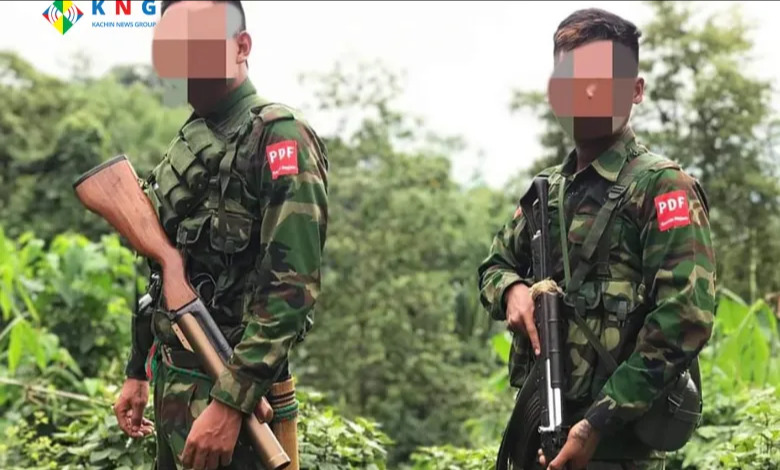
An officer from the Kachin People’s Defence Force (Kachin PDF), based in Hpakant Township, said that resistance forces that have taken up arms to overthrow the military dictatorship will also oppose any elections conducted by the junta.
“All resistance forces will move forward in line with the revolutionary path. The junta will try to gain legitimacy by staging a sham election and presenting itself as a government, and that will lead to major problems. They’re looking for a political way out and trying to prolong their grip on power as much as they can. They’re using local administrators and election candidates as pawns to achieve that goal. On our side, we will continue doing everything necessary to oppose the junta,” he told KNG.
There is also speculation among resistance fighters that holding elections in areas controlled by the KIA and other resistance forces is unlikely.
Earlier, some candidates from Momauk, Mansi, and Hpakant townships in Bhamo District, Kachin State, were preparing to contest the election. The KIA is attempting to capture Bhamo, the district capital and the second-largest town in Kachin State. However, when the UEC released the list of townships where voting will be held, these townships were not included.
A Kachin military analyst warned that the junta’s election, even if merely a sham, could escalate the military conflict in Kachin State.
“Even if the election goes ahead, there won’t be many MPs from Kachin State in parliament, because voting is planned in only nine townships. That means half of Kachin State’s MPs will remain unrepresented. Despite being clearly non-inclusive, the junta will hold the election without exception, so even if a government is formed afterward, the fighting will continue,” he said.
KIA Chair General N’Ban La also voiced serious concerns about the junta’s upcoming election during his speech on October 25, marking the 69th anniversary of the Kachin Independence Organisation (KIO), the KIA’s political wing.
He also warned that, whether willingly or under pressure, participating in the junta’s elections could significantly affect the fate of people across the country.
On one hand, the junta is deploying additional security forces and tightening inspections in towns, villages, and cities where the elections are scheduled. In July, the junta even enacted a law allowing the death penalty for anyone who disrupts, damages, or interferes with the election.
The UEC has published the names of four parties contesting only Kachin State constituencies, along with their candidate lists. These include the Kachin State People’s Party (KSPP), which enjoyed strong support in the 2020 election, as well as the New Democratic Party–Kachin (NDP-Kachin), Lisu National Development Party (LNDP), and Tai-Leng Nationalities Development Party (TNDP).
Meanwhile, around eight other parties, including the Union Solidarity and Development Party (USDP), People’s Pioneer Party (PPP), National Unity Party (NUP), Myanmar Farmers Development Party (MFDP), and People’s Party (PP), will compete in the nationwide election, including in Kachin State.
The junta is stepping up preparations for the election while simultaneously cracking down on opposition political forces, arresting and imprisoning their members. It has dissolved around 40 parties, including the National League for Democracy (NLD), the winner of the 2020 election. The junta-supervised vote has been criticized as a sham by Tom Andrews, the United Nations Special Rapporteur on the situation of human rights in Myanmar, as well as by several democratic nations.