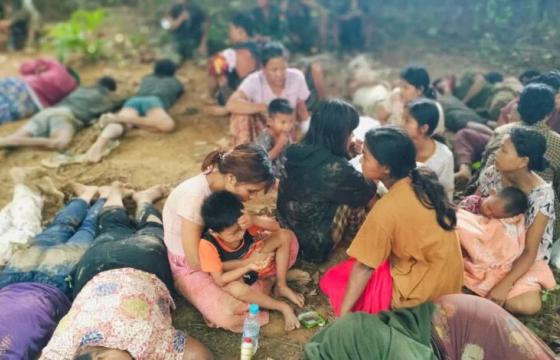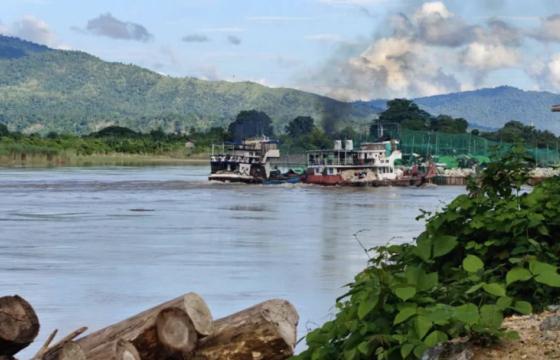

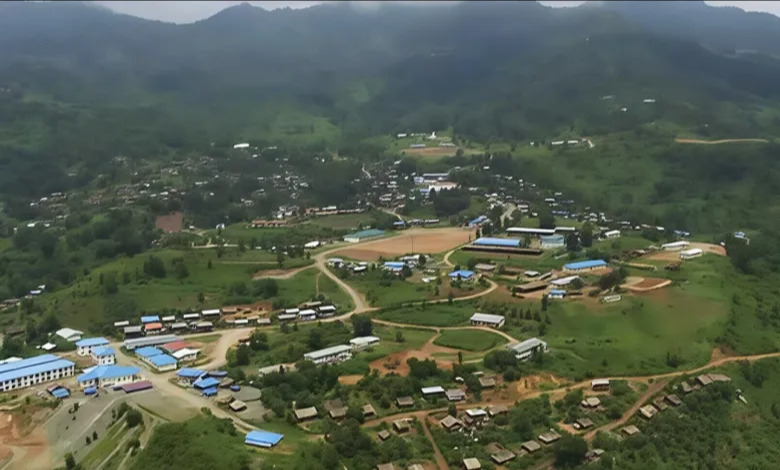
The junta’s closure of a vital waterway in the Naga Self-Administered Zone, part of Sagaing Region in northwest Myanmar, has led to rice and fuel shortages.
The junta’s closure of the Chindwin River waterway at Hkamti Town in Sagaing Region’s Hkamti Township, has caused severe fuel and rice shortages in Leshi and Lahe, towns in the Naga Self-Administered Zone, residents of these two towns reported.
Leshi and Lahe townships, which include the two towns, rely heavily on the Chindwin River for importing essential goods, but residents have faced severe hardships since the junta’s blockade began in the second week of August, a Lahe Town resident said.
“The junta has closed the waterway at Hkamti Town since August 12. While cargo boats are allowed to navigate as far as Hkamti, they are no longer permitted to continue toward Homalin and our town,” he told KNG.
An officer of the Yung Aung–led faction of the National Socialist Council of Nagaland–Khaplang (NSCN-K) suggested that the junta’s sudden closure of the vital regional waterway may signal upcoming military operations around Leshi.
“The only thing I can think of is that the junta closed the waterway to prepare for some kind of military action. Maybe it’s trying to clear the area before actually starting operations in Leshi and Lahe. It hasn’t given any reason for the closure, just shut it down suddenly,” he said.
NSCN-K is split into two factions, one led by Yung Aung and the other by Ang Mai. Ang Mai's faction has close ties to the junta, while Yung Aung's faction stands as an adversary to the junta.
Despite being closed to civilian use, junta soldiers are active along the Chindwin River, abducting young men from nearby communities in Leshi Township for conscription.
A dirt road connects Hkamti to Leshi and Lahe, usable only by motorbikes and small cars. During the rainy season, it becomes heavily damaged and difficult to pass, so people mainly rely on the waterway.
The junta’s current blockade is causing travel difficulties for locals, shortages of goods in the region, and rising prices.
Leshi and Lahe townships, which include around 100 and 70 villages respectively, are home to some 200,000 people, mostly of Naga ethnicity.