
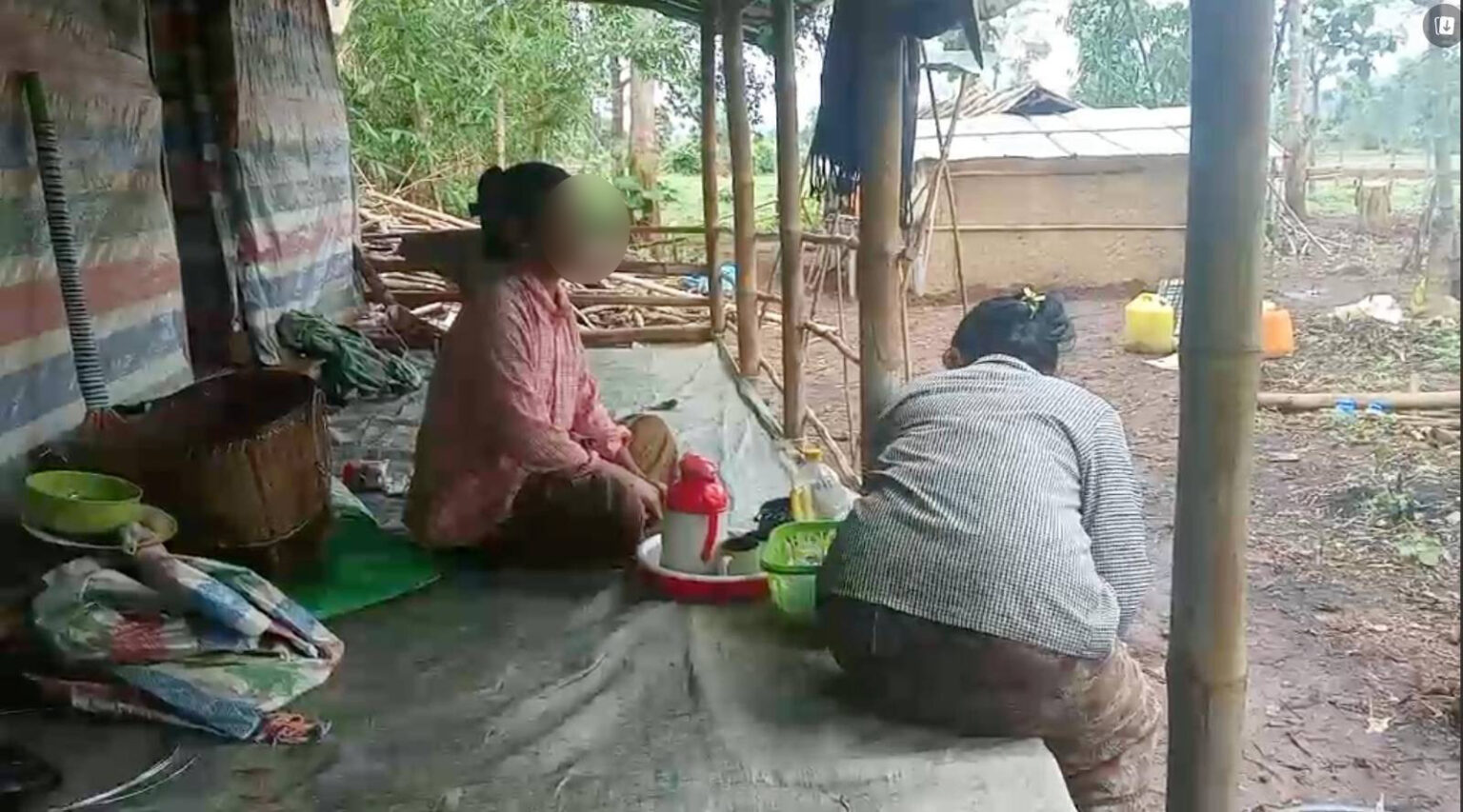
As light drizzle fell on Htaynghahlar displaced people’s (IDP) camp, in a flimsy hut two middle-aged friends, IDP women living in the camp, talked to Kantarawaddy Times.
The friends, Daw Hto Myar and Daw Myar Mo were both farmers who were forced by fighting to flee their villages in Pinlaung Township, southern Shan State. Though they are from the same township they are from different villages and only met in the IDP camp soon after they both arrived, about seven months ago. Since then they have helped support each other.
At 45, Daw Hto Myar is still strong and healthy after years working as a terrace farmer. Back in her native Hsawnglan (North) Village in Pinlaung Township, she was busy all year-round. She cultivated rice during both the summer and rainy seasons, and also grew corn and garlic as commercial crops.
But, she had to leave that life behind when she became an IDP. For someone accustomed to a physically demanding daily routine, she has found the sudden stillness and emptiness of life in the IDP camp overwhelming.
Daw Hto Myar said: Visiting a friend’s house and chatting with her gives me a bit of calm and lets me briefly escape from the reality I don’t want to face. When I’m alone, negative thoughts overwhelm me, and I just feel really tired.”
She also explained that at other times when she is alone she listens to music or quietly prays to try to make herself feel better.
In September 2024 Daw Hto Myar’s carefully tended paddy fields were full of ripe golden rice ready for harvest when fighting erupted in and around her village. Daw Hto Myar and the other villagers had no choice but to immediately flee and instead of harvesting their rice and corn crops they had to abandon them.
As the villagers fled, junta soldiers set fire to all of Hsawnglan (North) Village, destroying around 80 houses. The rice and corn fields the villagers had so carefully tended were burnt to ash.
Daw Hto Myar could not comprehend why the junta soldiers behaved so cruelly. She said: “I just can’t understand what grudge they could have against our village to destroy it like that.”
When Daw Hto Myar first left her village, she believed she would be back home within a week, or at the most ten days. Because she had to leave so quickly she only took a few things with her: two sets of clothes, some food, and bedding.
But now, Daw Hto Myar’s house, belongings, farm equipment, and valuable possessions are all gone, burnt by the junta soldiers. Even if she eventually manages to return to her home village after the fighting stops she cannot imagine how she will begin her life again from scratch.
“Even if the day comes when I can go home, I don’t know what I’ll decide. Our home is already gone. And if I stay here, I have no idea what kind of work I’ll do to make a living. I just feel so lost,” she said.
Daw Hto Myar’s friend, 53 year-old Daw Myar Mo, is also struggling with similar challenges.
Daw Myar Mo lived in Hsawnglan (South) Village in southern Shan State’s Pinlaung Township. Unlike Daw Hto Myar, Daw Myar Mo’s house is still standing, but it has been badly destroyed by junta artillery fire. Though she has not yet returned to her home, Daw Myar Mo has been told by others who have seen her house that all her household possessions and farm equipment have been taken or destroyed.
She said: “I think the total loss is probably around 40 to 50 million MMK, and that’s not even counting the value of my house.”
Since arriving at the IDP camp Daw Hto Myar and Daw Myar Mo have stopped receiving a regular income. Both are very concerned that their families will not have enough food or be able to meet their basic living needs every day.
Voicing her concerns about possible future food shortages Daw Hto Myar said: “We still have some rice from donors for now, but when it’s gone, where will the aid come from?” The question was quietly murmured, as if Daw Hto Myar was asking herself a question for which she knew, deep down, there was no answer.
“Could my family even starve tomorrow? How am I supposed to find a way to feed my children? These thoughts stress me out and really get me down,” she added.
On many days Daw Hto Myar and Daw Myar Mo have to skip a regular meal to ensure that their food lasts. This is a marked contrast to the women’s previous lives when they were running their own farms and never had to worry about food shortages.
Daw Hto Myar said: “We can’t be picky about what kind of curry we eat. We have to look for wild vegetables and eat whatever we can find, any edible leaves or fruits around here.”
Both women talk about how busy they would normally be on their farms at this time of the year if the war hadn’t come to their villages and uprooted them.
Daw Myar Mo said that for the women to be able to return to a peaceful life the revolution will have to succeed and until it does, they will have to continue suffering.
“We see other IDPs like us all over the forests. It’s not just us who are struggling. Sure, what we’re going through is really discouraging, but we keep going because we know we have to be strong for the country’s long-term peace,” she said.
In Pinlaung Township, where both Daw Hto Myar and Daw Myar Mo come from, fighting between Karenni resistance forces and the junta, aided by its ally, the Pa-O National Organisation (PNO) militia is still ongoing.