
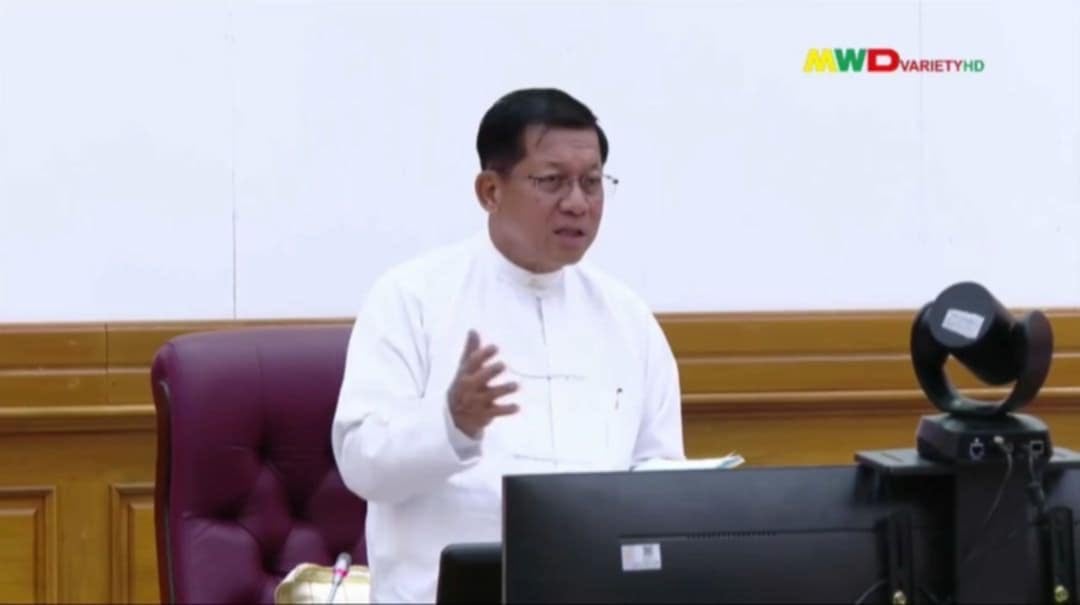
Myanmar’s junta chief, Senior General Min Aung Hlaing, has attributed the country’s escalating foreign exchange rates to increased outbound travel and foreign spending, despite Myanmar running a trade surplus.
Speaking on 20 May during the second day of a Military Council meeting in Naypyidaw, the military leader claimed that foreign travel by citizens and organizations has significantly raised the demand for foreign currency, fuelling exchange rate volatility.
“In addition to trade-related transactions, foreign trips and their associated spending have become a major factor in the surge of foreign currency demand,” Min Aung Hlaing said, defending the junta’s recent economic restrictions.
In response to the pressure on foreign reserves, the junta has reversed earlier policies allowing tax-free imports of electric vehicles (EVs). The tax benefits had been introduced to promote EV usage and reduce the nation’s heavy dependence on imported fuel, estimated at around five billion U.S. dollars annually.
Min Aung Hlaing reiterated his long-standing push for electricity-based transport during the meeting, saying the regime remains committed to developing electric cars and trains, despite the worsening nationwide electricity crisis following the 2021 coup.
However, critics note that EV imports have been largely dominated by businesses linked to the family of the junta leader. According to local media, Chinese-made electric vehicles are being imported through companies tied to Min Aung Hlaing’s son, Aung Pyae Sone, and daughter, Khin Thiri Thet Mon, raising concerns about profiteering under the guise of policy.
At the same time, the regime has enforced strict foreign currency controls targeting ordinary citizens. Myanmar workers abroad are required to convert 25 percent of their foreign earnings into kyats at junta-fixed rates and are now subject to income tax on those remittances.
Economists and rights groups argue that the junta’s monetary policies and deepening crackdown on foreign income are exacerbating public hardship and undermining economic recovery.
“It’s not foreign trips by ordinary people that are destabilizing the currency, it’s the junta’s mismanagement, corruption, and monopolization of trade routes,” said a Yangon-based analyst who requested anonymity for security reasons.
The kyat has seen significant depreciation since the coup, with informal exchange rates continuing to diverge sharply from official ones imposed by the military-controlled Central Bank.