
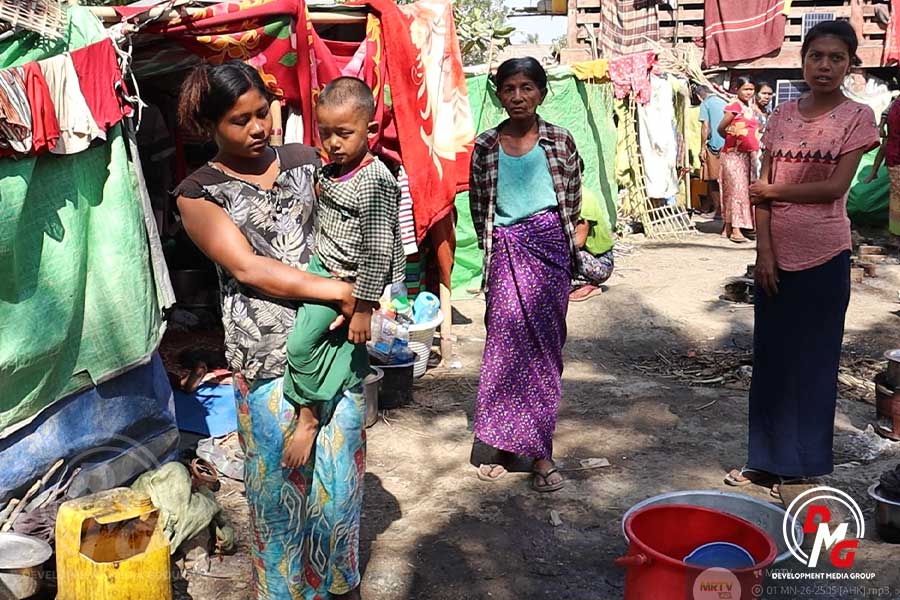
Women account for 57 percent of the more than 500,000 people displaced by ongoing military conflict in Myanmar’s Rakhine (Arakan) State, where they face severe health, hygiene, and security challenges, according to recent research.
A research bulletin released this month by the Institute for Strategy and Policy-Myanmar (ISP-Myanmar) highlighted that displaced women endure deeply insecure living conditions, exacerbated by a critical lack of designated toilets and bathing areas in displacement camps.
“Toilets and bathing facilities are totally inadequate. Nothing is convenient or sanitary,” said Hsan Kyaw, a displaced woman living in a camp near the Kyauktaw railway station. “Every morning, people line up for the toilet. The doors are broken and blow open in the wind, leaving us with no privacy. It is unsafe for a girl to go to the toilet alone.”
Beyond physical security risks, women are grappling with severe personal hygiene challenges due to limited healthcare access and soaring commodity prices.
Aid deliveries remain heavily restricted, leaving sanitary pads unaffordable or entirely unavailable for many, while pregnant and lactating mothers increasingly suffer from malnutrition.
“Distribution of sanitary items is irregular and insufficient. Those who cannot afford them have to go without,” said Nandar Win, a displaced resident and volunteer from Kyaukphyu Township. “When we face such situations, we feel too ashamed to go outside or speak to people. We urge organizations to provide sufficient latrines and menstrual hygiene products.”
The crisis spans multiple townships. Displaced populations in Taungup, Thandwe, Gwa, and Ramree are receiving minimal humanitarian aid and facing extreme hardship, according to local relief workers.
“Displaced people here face immense difficulties, including inadequate toilets and a shortage of menstrual products,” a relief worker in Taungup told DMG. “Few aid organizations operate in this area, and with jobs being scarce, livelihood conditions are extremely difficult.”
ISP-Myanmar emphasized that the combination of prolonged military conflict, security threats, and socio-economic collapse continues to inflict profound physical and psychological distress on women across the region.