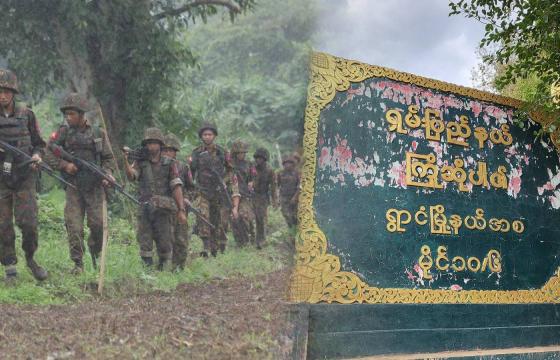

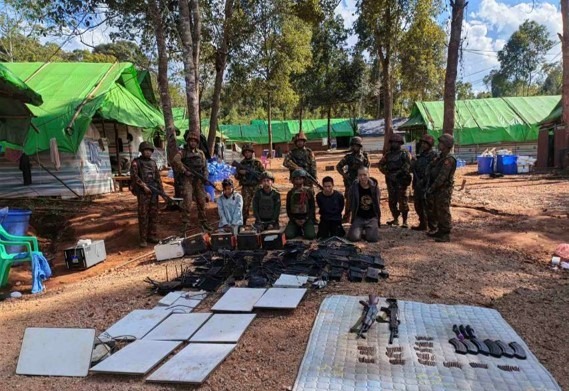
Transnational telecom scam syndicates, locally known as Zhapian gangs, have migrated far beyond their historical border strongholds, establishing sprawling criminal compounds deeper into southern and eastern Shan State following the operational shifts brought by ‘Operation 1027.’
Launched on October 27, 2023, the massive coordinated offensive by the Three Brotherhood Alliance—comprising the MNDAA, TNLA, and AA—explicitly pledged to eradicate cyber-scam operations.
However, subsequent ceasefires between the junta and northern alliance members through 2025 altered the security landscape.
While the AA continues its offensive in Rakhine State, fighting in northern Shan State has largely subsided.
According to the state-run Global New Light of Myanmar, authorities launched at least 46 crackdowns across Shan State between January and August 27, 2026, detaining roughly 2,400 individuals.
The arrests included over 2,000 Chinese nationals, 360 Myanmar citizens, alongside citizens from Malaysia, the Philippines, Vietnam, and Taiwan.
Despite these raids, analysts note a fundamental geographic shift.
The syndicates have crossed west of the Thanlwin (Salween) River into northern townships like Mongyai, Tangyan, Hsipaw, and Kyethi, while penetrating deeper into southern Shan State (Kunhing, Laihka, and Namsang) and Tachileik along the Thai border.
In March 2025, Chinese Foreign Minister Wang Yi claimed that cyber-scam operations had been completely eradicated—a declaration dismissed by regional observers as mere state propaganda.
"The Chinese foreign minister’s claim that the Zhapian gangs have been completely wiped out is just state-level propaganda. It’s not possible to eliminate these groups because they’re part of a huge, interconnected global network," said Shan political analyst Sai Wan Sai.
Operating out of massive, heavily fortified compounds capable of housing hundreds of workers, the syndicates rely heavily on unauthorized Starlink satellite internet dishes—with more than 140 devices seized over eight months—to sustain their digital operations.
Locals and analysts assert that such conspicuous mega-compounds can only flourish because local authorities and armed factions are turning a blind eye in exchange for illicit profits.
"The regime has ties with various border forces and militias. It’s very obvious that both the junta and some EAOs are entangled with these illegal businesses in one way or another," Sai Wan Sai warned, adding that both the regime and allied armed groups likely rely on scam revenues to fund military activities.
Comparing the evolution of cyber-scam networks to the historical entrenchment of the Southeast Asian drug trade, analysts warn that without genuine cooperative action, the syndicates will continue to adapt, posing a long-term cross-border threat to regional security and fueling severe human trafficking crises.