
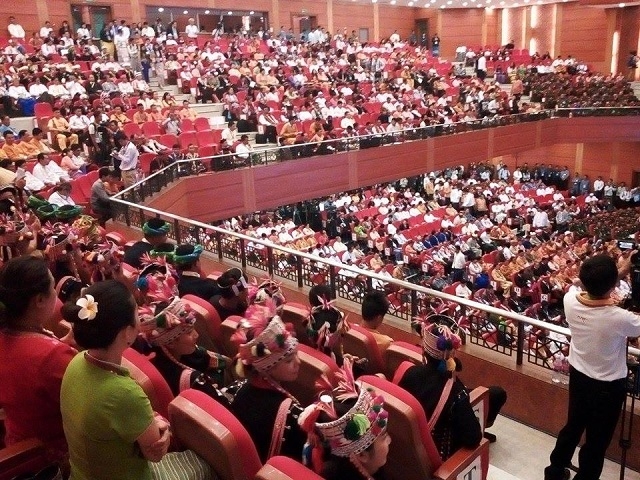
More than 70 proposals were presented at last week’s four-day Union Peace Conference in Naypyidaw, the first in a series of peace talks dubbed the 21st-Century Panglong Conference.
One of the most controversial proposals was the demand for self-rule and autonomous states by several ethnic minority groups, particularly in Shan State.
The ethnic groups that demanded their own self-administered states include: the United Wa State Army (UWSA), arguably Burma’s strongest ethnic armed group, which does at present fall within a self-administered division; the Ta’ang (Palaung) National Liberation Army (TNLA); the Pa-oh; and Tai Leng group. Meanwhile, the National Democratic Alliance Army (NDAA) based in Mong La demanded a self-administered zone for ethnic Akha people.
Asked to clarify his position on the issue, Maj. Sai Nguen, the spokesperson for the Restoration Council of Shan State/Shan State Army (RCSS/SSA), said that it is every ethnic group’s right to make such a request. However, he said that these matters are directly concerned with the central government, and therefore fall under the 2008 constitution.
He explained that several stages must be met in order to form an autonomous state.
Gen. Hso Ten, a veteran of the Shan State Progress Party/Shan State Army (SSPP/SSA), said that in order to establish a new state, a detailed process must be followed.
“It does not depend on us [SSPP/SSA],” he said. “It needs to pass through parliament and the Shan State people. It is not so easy just to establish a new state.”
He added that such a new state would have to depend on ethnic populations, as well as language and literature.
“It’s their [ethnic minorities’] right and we cannot stop that,” said Khuensai, the director of the Pyidaungsu Institute for Peace and Dialogue.
He recalled that Mahatma Gandhi had once said, “I do not accept what you have spoken, but I will protect you with my life that you have a right to speak.”
Khuensai continued: “What we have to consider is the loss we are facing as the majority group.
“But whatever we lose, they will also lose. We all faced with losses.”
He concluded: “What we have to do now is establish equal rights. And the best way to do that is to sit together and discuss the issues until we have solutions.”
By Shan Herald Agency for News (SHAN)