
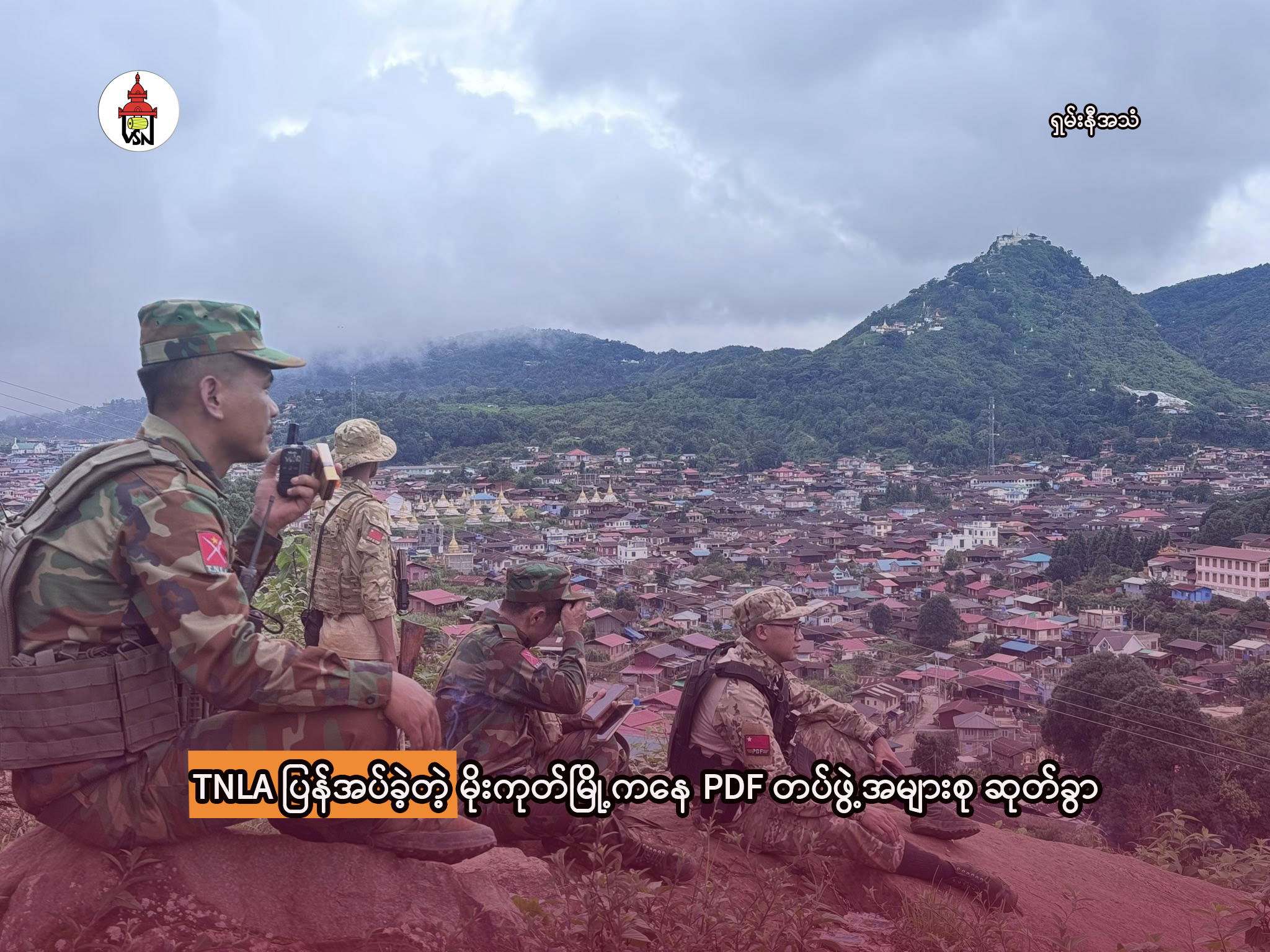
Most People's Defence Force (PDF) fighters stationed in Mogok Township, Mandalay Region, withdrew after the Ta’ang National Liberation Army (TNLA), a Palaung ethnic armed group, handed Mogok Town, the township’s administrative center, over to the junta last year.
Although the TNLA handed Mogok to the junta under a China-brokered ceasefire agreement, its former ally, the PDF, maintained a presence in Mogok Township and continued fighting the junta for over three months.
“If it takes too long, the PDF’s exit could be completely cut off. Right now, it’s still able to withdraw from Kyauksin and Bawmar villages in the western part of the township, but soon its troops could be fully trapped. There has already been fighting around those villages recently,” a Mogok resident told the Voice of Shan-Ni.
Locals said that nearly all western parts of Mogok Township, once dominated by the PDF and local resistance forces, are now under junta control, leaving the group with increasingly limited exit routes.
Although clashes between the junta and the PDF continued in Mogok Township after the TNLA withdrew, fighting has completely subsided in recent days, with at least three sources in the township confirming the PDF has withdrawn.
Before these resistance units withdrew, skirmishes with the junta broke out around villages such as Sakhangyi, Kyauksin, Bawmar, and Kyauknagar.
The PDF’s command body, the Ministry of Defence under the resistance-run National Unity Government (NUG), oversaw operations in Momeik (Mongmit) Township in northern Shan State and Mogok Township, both of which the TNLA handed back to the junta in exchange for the ceasefire.
Resistance fighters from the Mogok Tactical Command, Myingyan Black Tiger, Ayeyarwady Delta Region Force, and the Mogok-Momeik Command, People’s Liberation Army Battalion 513, Red Wolves of Mogok, Ruby Land PDF, Sagaing PDF and Mogok People’s Defence Team jointly took part in operations in Mogok Township.