
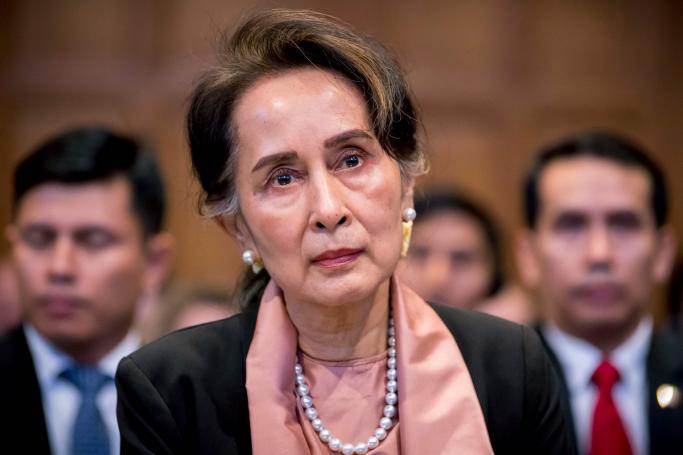
One of the Myanmar military's first moves during its coup last year was to place Aung San Suu Kyi, the country's de facto civilian leader and a democracy figurehead who has spent decades battling military rule, under house arrest.
On Thursday, the junta announced the Nobel laureate, 77, would be shifted to solitary confinement in prison in the capital Naypyidaw.
AFP takes a look at what we know about Suu Kyi's new confinement.
- Where is she now? –
After more than a year of house arrest at an undisclosed location in Naypyidaw, Suu Kyi was on Wednesday moved amid high security to a prison compound on the western side of the sprawling military-built capital.
Satellite imagery shows a series of buildings surrounded by a wall and set back from a main road, but details on where in the complex she is being held are scant.
Richard Horsey of the International Crisis Group (ICG) said reports indicated Suu Kyi would be housed in a "purpose-built dwelling" in the prison.
- What are her new conditions like? –
Suu Kyi will no longer be attended to by the ten or so domestic staff who accompanied her during her house arrest.
Instead, prison authorities will provide three female helpers to look after her, said a source with knowledge of the matter.
Suu Kyi will also be without her dog Taichido -- gifted to her in 2010 by her UK-born youngest son when he made a rare visit to Myanmar, according to local media.
Her new conditions are a far cry from the years she spent under house arrest during the previous junta, when she lived at her family's colonial-era lakeside mansion in Yangon and regularly gave speeches to crowds on the other side of her garden wall.
- Why have they moved her? -
Up until now Suu Kyi -- the daughter of independence hero Aung San -- had largely been spared the time inside prison given to thousands of other democracy activists during decades of military rule.
"It's hard to explain their reasoning for this decision after more than a year" of house arrest, a former lawmaker from Suu Kyi's National League for Democracy party, who did not want to be named, told AFP.
The move was "cruel and there is no doubt malice behind it", said ICG's Horsey.
"But there can also be logistical reasons -- the regime can easily force her to attend court hearings inside the prison, whereas before she had sometimes declined to travel" to the court, he said.
Independent analyst David Mathieson said the move was "certainly a sign they don't care about her welfare".
- How is she doing? –
Suu Kyi remained sanguine after the transfer to jail, a source with knowledge of the case told AFP.
"She is used to facing any kind of situation calmly," said the source, who requested anonymity.
Suu Kyi spent around 15 years under house arrest under previous juntas, leading a simple life dominated by reading, meditation and prayer.
"It was important to establish a routine and to follow it strictly to avoid a feckless squandering of time", she wrote in the 1990s.
She has, however, missed several hearings in her trial and has sometimes appeared tired by the frequency of her near-daily court appearances.
- What now? –
Her trial on a slew of corruption and other charges -- which rights groups decry as a sham -- will continue inside the prison compound, the junta has said.
Suu Kyi faces a prison sentence of more than 150 years if found guilty on all counts. She has already been convicted of a number of offences and sentenced to 11 years imprisonment.
"What else is there to assume other than the junta wants to ensure she spends the rest of her life behind bars," Manny Maung of Human Rights Watch told AFP.