
The Karen Peace Support Network (KPSN) released a new report on 9 December 2025 as part of their continuing analysis of the conflict and governance changes taking place in Kawthoolei since the 2021 military coup.
The report aims to highlight what happens once areas of Myanmar are freed from the junta occupation. The group notes that this receives less attention than the junta’s territorial losses or gains.
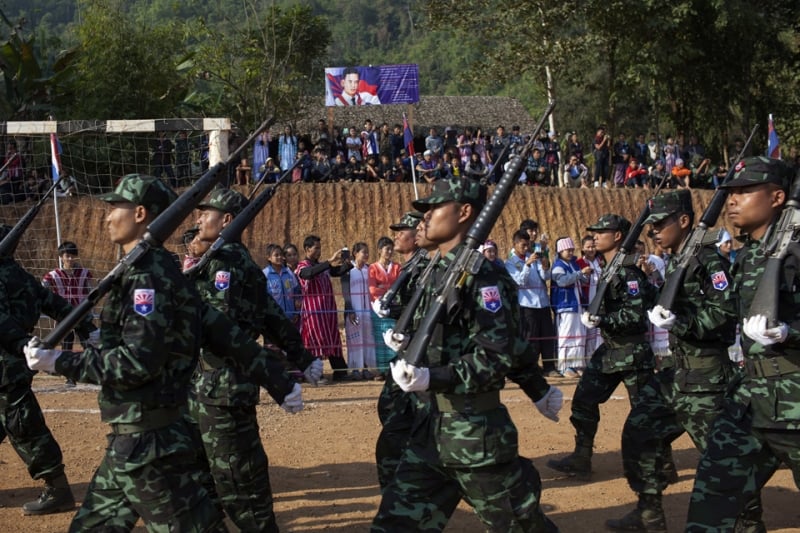
The Karen National Liberation Army (KNLA) and its allies have now liberated almost the entire eastern border of Kawthoolei since the 2021 coup. People living in these areas, KPSN says, are now free from the junta’s rule.
Kawthoolei is considered by the Karen National Union (KNU) to encompass Karen State and parts of Mon State, Bago Region, and Tanintharyi Region. Its eastern border forms a major portion of Myanmar’s international border with Thailand.
In gaining control of most of the border, the KNLA has captured at least 55 military camps in the last 13 months. This brings the total number of military camps taken by the KNLA and its allies since February 2021 to 193 across the KNU’s seven districts in Kawthoolei.
In one example, on 14 November 2025, the KNLA and its allies retook the Mawdaung camp in Mergui-Tavoy District located in Tanintharyi Region.
Despite these military victories, the junta has started bombing and shelling civilian buildings in Kawthoolei more frequently in a bid to frighten the local population. In the thirteen months between September 2024 and September 2025 junta forces attacked 108 civilian buildings, including schools, clinics, monasteries, and churches, across all seven KNU districts. This is much more than the 97 attacks in the previous 43 months.
Even with these challenges, KNU local administration bodies in the freed areas are providing important services. Data from the Karen Education and Culture Department (KECD) shows that KNU schools grew by 23%, from 1,361 in the 2020-2021 school year to 1,671 in 2024-2025. For health, the KNU’s Department of Health and Welfare (KDHW) has expanded its facilities from 60 in 2022 to 90 hospitals and clinics today.
However, the military’s attacks have forced more people to flee from their homes. The total number of internally displaced persons (IDPs) in Kawthoolei has grown by 14% since September 2024, now reaching 1,204,932 people.
The KPSN is urgently asking for more cross-border humanitarian aid for these displaced people. The group estimates the cost to be $111 million to provide rice to all 1,204,932 IDPs for six months.