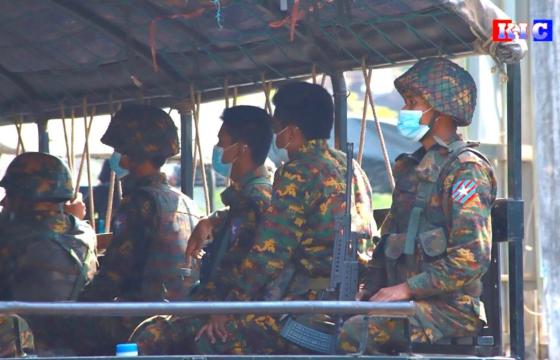


The largest state in Burma also has the highest number of human rights violations in the country, according to a recent report.
Han Gyi, coordinator for the Network for Human Rights Documentation-Burma (ND-Burma), told KIC News that out of the 98 violations reported in Burma from January to June this year—an increase from 84 recorded last year—his organization counted 54 cases in Shan State in their new report.
“As most of the military conflicts took place in northern Shan State, human rights violations rank the highest in these conflict areas. We mostly found tortures and killings,” he explained.
The violations included cases of civilians in conflict zones being tortured by the Burmese military under the pretense of collaboration with armed groups, with some interrogations ending in death.
The report also found ethnic armed groups were responsible for committing human rights abuses.
Violations were classified as: arbitrary/illegal arrest/detention; confiscation/destruction of property; disappearance; forced labour; forced relocation; human trafficking; killing; obstruction of freedom of expression/assembly; rape; other sexual violence; torture; use of child soldiers; and arbitrary taxation.
Kachin State held the notorious title of having the second highest occurrences of human rights violations.
The report detailed the on-going conflicts taking place in both states—mainly, between the Burma Army and armed groups, Ta’ang National Liberation Army; the Kachin Independence Army; and Shan State Progress Party/Shan State Army.
However, it also recorded rights abuses that have resulted from fighting between the Restoration Council of Shan State/Shan State Army and Ta’ang National Liberation Army.
Information about the two villagers that were killed by Burma Army in Ye Township in Mon State was included in the report.
The ND-Burma is urging for the government to ratify the UN Convention Against Torture and other Cruel, Inhuman and Degrading Treatment or Punishment and its Optional Protocol—a commitment that was made under the previous U Thein Sein administration.
The ND-Burma that was formed in 2004, drawing members from ethnic groups, youth and women organisations, and other human rights watchdog organisations, monitors human rights violations in Burma, sometimes seeking justice for victims.
Reporting by Sa Isue for KIC News
Translated by Thida Linn
Edited by BNI staff