
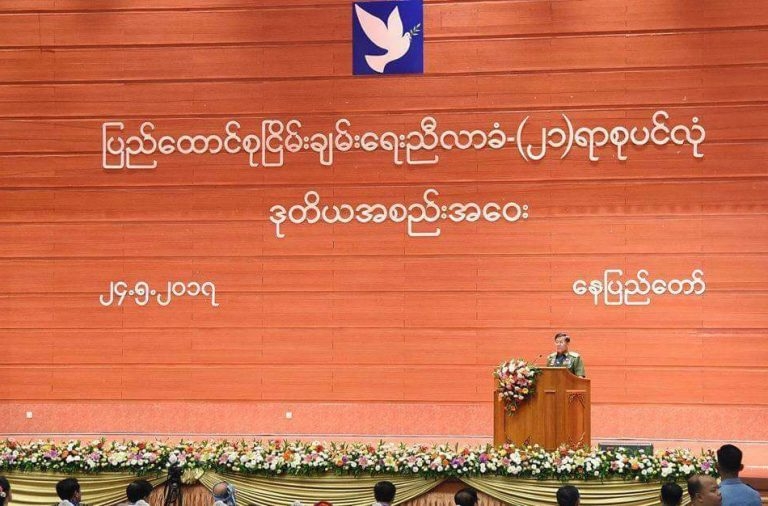
For a meeting meant to build peace, the second session of the 21st-Century Panglong Conference got off to a divisive start with Commander-in-Chief Senior General Min Aung Hlaing launching immediately into a criticism of the ethnic armed groups.
In his opening speech, the Tatmadaw chief slammed some ethnic armed organizations for pursuing unrealistic demands, which he compared to an attempt to undermine the Union. He took particular issue with a coalition of ethnic armed organizations that rejected the nationwide ceasefire agreement (NCA) and vowed to forge an alternative route to peace.
“The NCA has already covered all the points demanded by the national races. Ignoring this agreement to pursue another, or second way, will be seen as an attempt to spite the Union, which is based on the values of peace, democracy and federalism,” he said. “We have to assume that the attempt [in seeking an alternative to the NCA] is tantamount to grabbing power and splitting from the Union through armed struggle.”
He added that the Tatmadaw remains committed to trying to secure peace throughout the country via the mechanisms agreed to in the NCA, including building a democratic federal Union based on the results of political dialogues. The Tatmadaw remains loyal to the state and to the people, he said, before reiterating the Tatmadaw’s “six-point peace policy”, which requires ethnic armed groups accept the 2008 constitution, and agree to disarm. These points are disputed by many of the ethnic armed groups, which have pushed for constitutional amendment as the basis for peace.
After studying the 72 papers submitted to the previous iteration of the Panglong meeting, Snr Gen Min Aung Hlaing said some of the ethnic armed groups’ demands go far beyond the right to autonomy, and in some cases run counter to the wishes and needs of the people.
Earlier this year, several ethnic armed groups, including members of the Northern Alliance currently engaged in fighting the Tatmadaw, joined with the powerful United Wa State Army in sidestepping the NCA, and agreeing to jointly pursue alternative methods for peace.
Nevertheless, the groups are in attendance at the peace conference, while the ethnic umbrella organization, the United Nationalities Federal Council, has skipped the conference following a dispute over their role and ability to fully participate in the May 24-28 event.
Translated by Thida Linn
Edited by Laignee Barron