

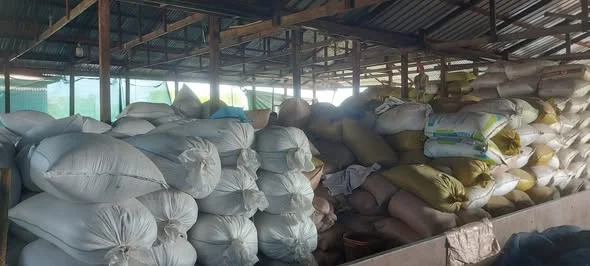
Paddy prices across all varieties have surged in Mon State ahead of the upcoming monsoon harvest, driven by shrinking market stocks, high demand, and widespread flood damage, local farmers said.
Prices for unhusked rice (paddy) now range from 4 million to 5 million kyats per 100 baskets (roughly 2.1 metric tons), depending on the variety.
A farmer from Paung Township told the Independent Mon News Agency (IMNA) that local stocks are nearly exhausted as growers were forced to sell early to raise working capital for planting.
“Prices jumped by more than 500,000 kyats in just one week, but there is hardly any paddy left to sell,” the farmer said. “When we needed cash for farming, we started selling at around 3.5 million kyats. By the time it hit 4 million, most farmers had already sold off their stock.”
Prices vary across districts, however, and some farmers are holding onto their remaining yield in anticipation of further price hikes.
“In our village, no one has sold their stored paddy yet,” said a farmer from Kyaikmaraw Township. “We plan to sell before the new monsoon crop arrives. If prices rise above current levels, we’ll sell, but for now, we’re holding out.”
Soaring input costs—particularly for fuel and fertilizer—have sharply reduced the acreage planted for this year’s monsoon crop. Farmers say sustained high prices are essential if farming is to remain financially viable next season.
“Everything, including land preparation, has become far more expensive,” explained a farmer from Mudon Township. “During the summer, we got only around 2 million kyats per 100 baskets. Now it has doubled to 4 million. Prices need to stay at this level for us to survive next year.”
Compounding the crisis, heavy rains have triggered severe pest infestations—including onion thrips and rice bugs—alongside widespread rodent damage across Mon State’s paddy fields.
Meanwhile, market observers note that holding stock remains a gamble, as the new harvest is still several months away.
In August, the junta-controlled Myanmar Rice Federation issued a statement urging traders not to mark up stored stock and to sell rice at affordable rates to the public—an appeal that comes as tens of thousands of acres of farmland remain submerged by severe flooding.