
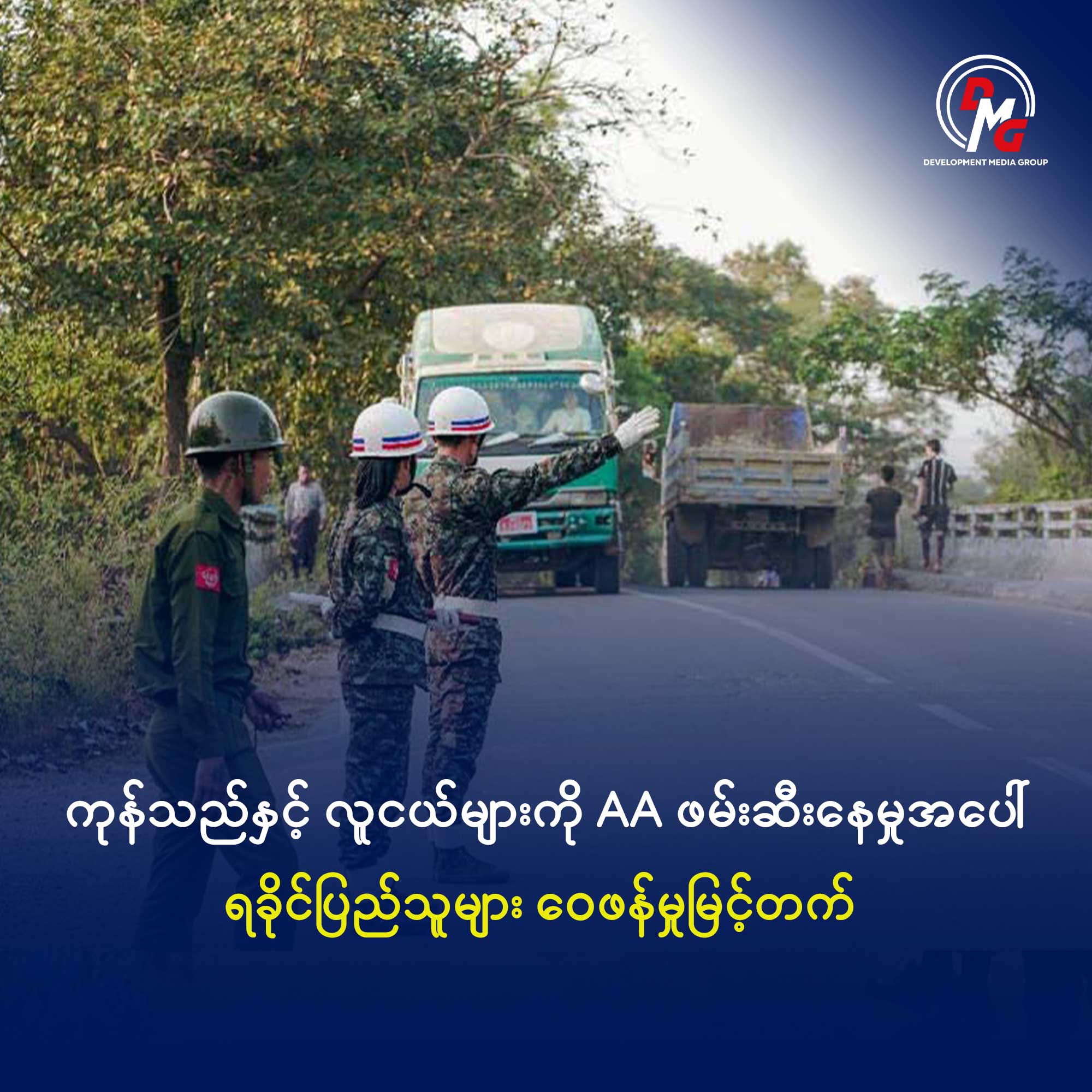
An increasing number of Arakan residents are voicing frustration over the Arakan Army’s (AA) detention of traders and young people at checkpoints in Paletwa Township, Chin State, where AA authorities are reportedly restricting travel out of Arakan State.
In the past, travel outside the region was permitted if individuals could present four recommendation letters issued by relevant AA-run administrative bodies. Residents now say that even those who meet all requirements are being stopped, detained, and in some cases transferred for military training.
“We saved every bit we could just to buy goods. We followed their rules, got the recommendation letters, and had guarantors as required. They told us we’d be allowed to travel if everything was in order—but he was still taken. We have no idea where he is now,” said a relative of a man from Kyauktaw Township who was recently detained.
The 29-year-old man, from an undisclosed village in Kyauktaw Township, was arrested at a Paletwa checkpoint in the fourth week of April while on his way to India to purchase goods. His identity and exact address have not been disclosed for security reasons.
Under current procedures, travelers must secure recommendation letters from the village administration office, regional office, police station, and township administration office. Despite complying with these steps, multiple reports indicate that arrests continue along the route.
Since the junta blocked the inflow of goods into Arakan State in November 2023, residents have increasingly depended on trade routes to India and Magway Region to access essential supplies.
Observers warn that the detentions are already discouraging transport operators and traders, raising concerns about wider economic consequences.
“Boat operators are stopping work because of the arrests. Before, one trader might hire four or five boats, but now that number has dropped sharply. The routes to India are technically open, but once people leave, there’s no way to stay in touch. That uncertainty is scaring people off. If this continues, shortages and higher prices are inevitable,” said an Arakan trader.
Although detentions are being reported at AA checkpoints near the India border in Paletwa, some individuals—particularly older people and those with health issues—have been released.
“Five people from our village were detained at a checkpoint in Paletwa. One was released after showing medical records proving he wasn’t fit. Three others, aged between 37 and 40, were also let go. From what we can see, those between 18 and 35 are the main targets for military service,” said another resident of Kyauktaw Township.
The AA introduced the National Defense Emergency Provision (NDEP) on May 22, 2025, barring people aged 18 to 45 from leaving Arakan State. The policy requires two years of military service for women aged 18 to 25 and men aged 18 to 45, with exceptions granted only to patients whose conditions cannot be treated locally.
Under the same provision, only those suffering from serious or life-threatening illnesses that cannot be treated within Arakan State are allowed to travel for medical reasons. Others must remain in the state until restrictions are lifted.
“Trading with India has been going on for years. These arrests only started after the military service order came out. If people aren’t allowed to travel, then issuing recommendation letters doesn’t make sense. The AA should take public concerns seriously and handle this fairly instead of treating criticism like an attack,” said a resident from Mrauk-U Township.
Faced with economic hardship and limited access to education and employment, many young people in Arakan State are attempting to leave for mainland Myanmar or other countries. While some are detained by the AA, others risk being forcibly recruited at junta checkpoints both inside Arakan State and elsewhere in Myanmar.
The AA currently administers 14 townships in Arakan State, along with Paletwa Township in Chin State.
Ongoing fighting in Sittwe and Kyaukphyu, coupled with security concerns along the border involving armed groups like the Arakan Rohingya Salvation Army (ARSA), has led some to argue that young people should remain and contribute to the defense of their home region.