
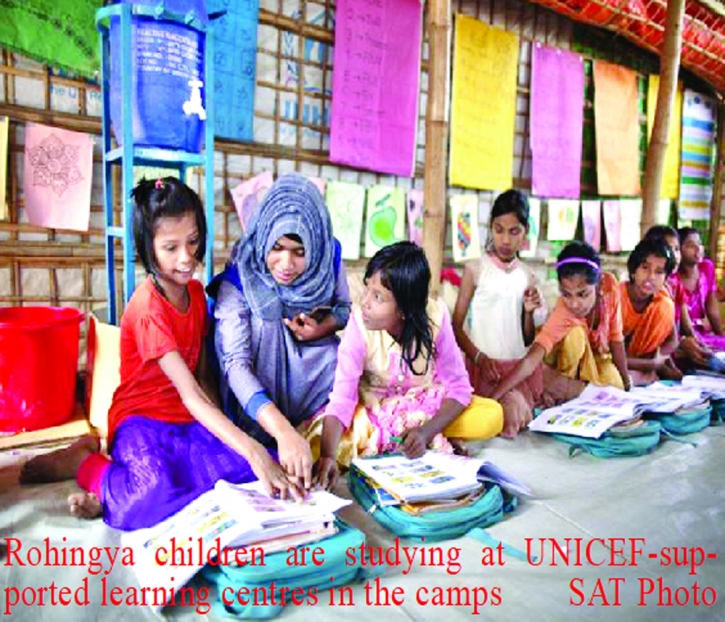
The government has approved a proposal to provide pre-primary and primary education services in Rohingya refugee camps through UNICEF, aiming to improve access to structured learning for forcibly displaced Myanmar nationals living in Cox’s Bazar, Bandarban, and Bhasan Char in Noakhali.
The approved initiative involves an estimated expenditure of Tk 203.87 crore, to be financed jointly by the Government of Bangladesh (GoB) and a grant from the World Bank.
The decision was taken at a meeting of the Advisers Council Committee on Government Purchase, held at the Secretariat on Tuesday. The proposal was placed before the committee by the Ministry of Primary and Mass Education.
Under the plan, education services will be procured through UNICEF as part of the SD-4 package of the project titled “ISO Component-One: Pre-Primary and Primary Education Improvement Project in Cox’s Bazar and Bandarban Districts and Bhasan Char of Noakhali.”
According to officials familiar with the meeting, the initiative under Component-1 of the project is designed to engage forcibly displaced Myanmar nationals in productive activities and enable them to acquire basic skills through structured education delivered in their mother tongue.
In line with this objective, UNICEF was invited under a single-source procurement method to submit a proposal for implementing the education programme. The proposal was subsequently reviewed, evaluated, and negotiated jointly by the Directorate of Primary Education (DPE) and the World Bank’s education team.
Following the completion of negotiations, approval was sought to award the package to UNICEF at a cost of USD 18.45 million, equivalent to Tk 203.87 crore, calculated at the Development Project Proforma (DPP) exchange rate of Tk 110.502 per US dollar. The committee approved the proposal accordingly.
The project had earlier received approval from the Executive Committee of the National Economic Council (ECNEC) on May 28, 2024, with an implementation period set from July 1, 2024 to June 30, 2027.
Under the agreement, the World Bank will directly disburse the full USD 18.45 million to UNICEF in US dollars.
Sources noted that although the approved DPP initially предусмотрed implementation through open tendering, the decision to engage UNICEF was made in compliance with the conditions outlined in the World Bank’s grant and loan agreements.
As part of the programme, 256,490 Rohingya students will receive education support in the Myanmar language. To deliver the services, 4,106 volunteer teachers will be recruited during the first 12 months, followed by an additional 3,700 volunteers over the next six months.
The recruited teachers will receive honorariums in accordance with rates determined under the project framework.