
The junta claimed it is strengthening its Air Force and acquiring weapons systems to address both conventional warfare and unconventional military challenges.
General Htun Aung, Commander-in-Chief of the Air Force, said the junta is ramping up efforts to transform the Myanmar Air Force into an international-standard force by acquiring fixed-wing aircraft, helicopters, and drones, while also expanding its weapons systems.
He made the claim during a graduation ceremony at Shante Air Base, the Air Force’s main pilot training facility in Meiktila, Mandalay Region, on January 21.
General Htun Aung said that acquiring advanced aircraft and weapons systems alone is not sufficient, stressing that continuous training is essential for the air force to operate them effectively and fully realize their capabilities.
He added that, alongside preparations for conventional warfare, the air force is also developing and putting in place policies to better respond to unconventional military challenges.
Sergeant Zay Ya, who previously served in the junta’s air defence but later joined the Civil Disobedience Movement (CDM), an anti-coup campaign in which civil servants and security personnel refuse to work for the regime, said the junta appears to be seeking to expand its unilateral air superiority in its fight against resistance forces.
“The junta is getting ready to buy more transport aircraft, likely the same models it is already using, and that is worrying. It appears to be trying to further strengthen its existing air superiority. In modern warfare, heavy air assaults followed by ground attacks are highly effective, and the junta is likely to rely on this tactic more frequently,” he told Than Lwin Times.
The armed resistance sparked by the 2021 coup has caused some of the most unprecedented setbacks in Myanmar’s military history. Since Operation 1027, a major resistance offensive that resulted in the loss of many bases and military positions, including two regional military command headquarters, the junta has stepped up efforts to rely more heavily on its air superiority.
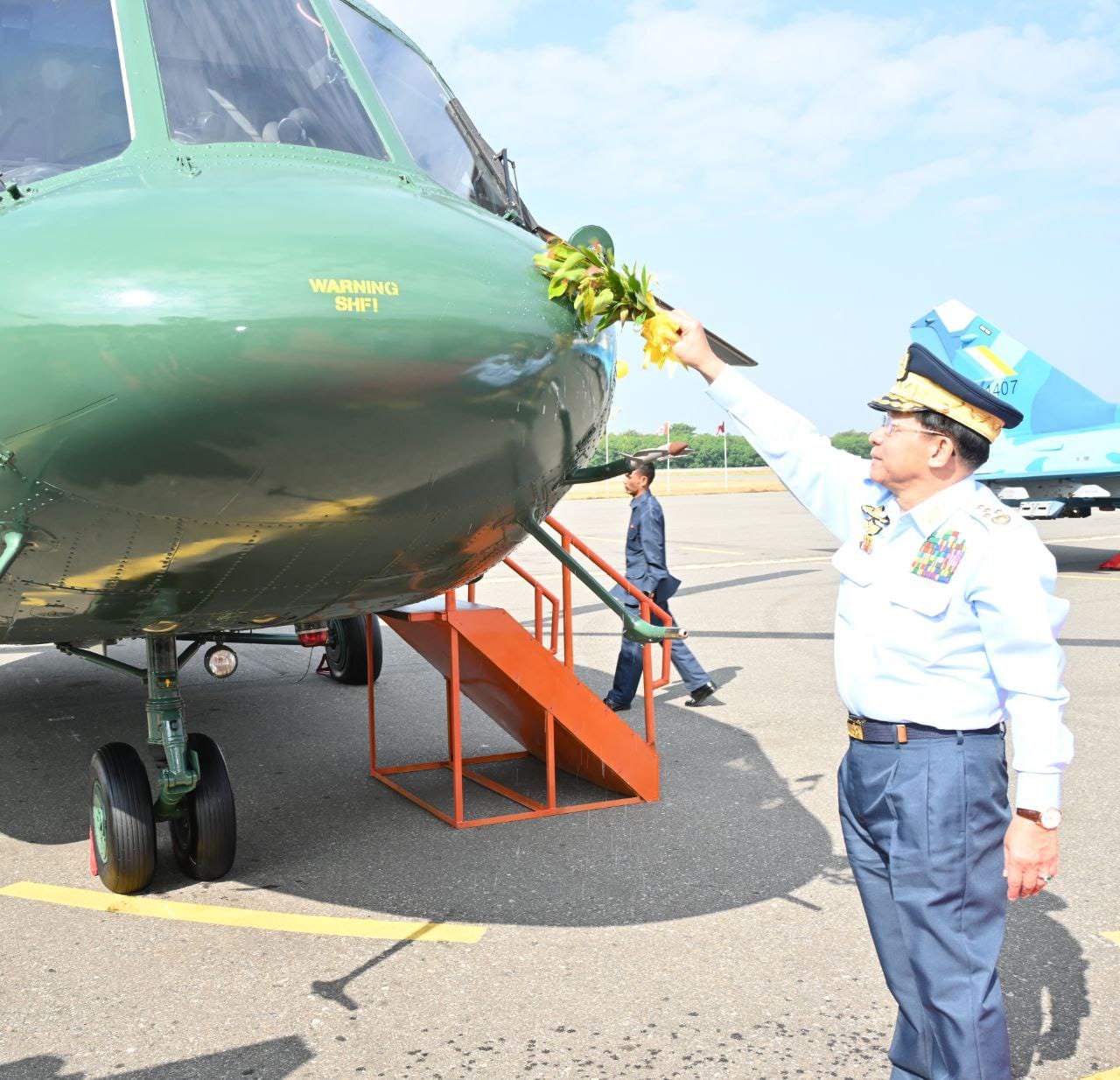
The junta has increasingly relied on air power not just for combat, but also for transporting reinforcements and supplies. In addition, drones, paramotors, and gyrocopters are being deployed, while purchases of fighter jets and helicopters have also increased. On November 7, the junta inducted three new transport helicopters and two additional aircraft during a ceremony in capital Naypyidaw.
Since the coup, with no parliament in place and virtually unlimited control over the government budget, the junta has increased defense spending every year. It was announced that the defense budget from the time of the coup through the 2023–24 fiscal year exceeded 5,600 billion MMK, while figures for subsequent years have not been released. For the 2025–2026 fiscal year, spending for the Ministry of Home Affairs and the Ministry of Defense has been increased, though the exact amounts have not been officially disclosed.
Meanwhile, the junta has intensified air operations, deploying reconnaissance drones alongside conventional aircraft to carry out bombing missions in areas held by resistance forces.
The resistance-run National Unity Government (NUG) reported that the junta’s airstrikes have killed more than 2,300 civilians nationwide in just the past year. Over 8,800 airstrikes have reportedly struck the country, damaging more than 3,500 homes, over 100 schools, and nearly 230 health and religious facilities, according to the NUG.
Reports from independent research organizations also indicated that many of the junta’s airstrikes have targeted residential areas, villages, and health and education facilities. Military analysts believed that the junta has deliberately used its air power to carry out assaults in resistance-held areas, aiming to instill fear among local populations and undermine the resistance’s efforts to establish governance structures.
CDM Sergeant Zay Ya commented that the junta is likely to escalate air assaults in the central dry zone, locally known as Anyar, where armed resistance is strong, after attempting to cut off the flow of weapons to resistance groups.
“Given the terrain, the junta is more likely to use light aircraft like gyrocopters and paramotors rather than warplanes in Anyar. They’re cheaper and easier to deploy in large numbers. In contrast, in highland areas and ethnic regions, the junta is more likely to conduct bombing raids using fighter jets,” he said.
Thanks to mediation by the Chinese government, the junta reached ceasefire agreements with the Myanmar National Democratic Alliance Army (MNDAA) and the Ta’ang National Liberation Army (TNLA) in northern Shan State, and airstrikes in the region have also been halted.
On the other hand, the junta has intensified airstrikes in Arakan (Rakhine) State, where it has lost control of 14 townships to the Arakan Army (AA), and is preparing to carry out similar attacks in other resistance-held areas and ethnic regions.
Research by Justice For Myanmar (JFM), published on June 30 last year, revealed that the government of Belarus, an ally of the coup junta, maintains significant military cooperation with Myanmar’s military.
Leaked correspondence between Myanmar's air defence command and Belarusian authorities confirmed the transfer of advanced military systems, including a Myanmar Air Defence Operational Command (MADOC) system, V3D radar technology, and ground-based missile systems, according to the JFM.