
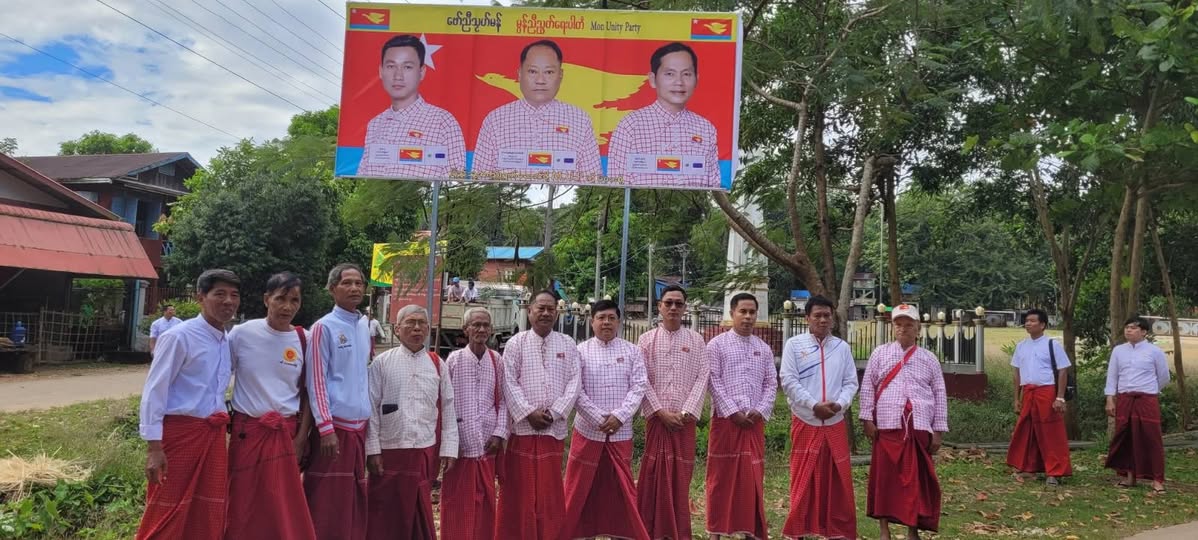
The Mon Unity Party (MUP) captured a record number of seats in its history during the junta-run, phased election.
The MUP did not compete at the national level, focusing instead on Mon State. In the first round of voting on December 28, it won only two seats in Chaungzon Township under the First-Past-the-Post (FPTP) system. In the second round on January 11, the party added 10 more seats to its total.
Furthermore, based on the number of votes it received, it won two seats in the National Assembly and three seats in the State Assembly under Proportional Representation (PR) voting, the party announced on Facebook.
The MUP contested the 2020 election nationwide but secured only 11 seats in Mon State constituencies. In the current junta-run election, held under a mix of Proportional Representation (PR) and First-Past-the-Post (FPTP) systems, the party increased its haul to 17 seats.
The National League for Democracy (NLD), led by imprisoned State Counsellor Daw Aung San Suu Kyi, the most popular pro-democracy party in Myanmar, did not participate in the election, leading the public to overwhelmingly vote for what they believed would be the next best option, a Mon State resident told Than Lwin Times.
“The NLD not being in the election really helped the MUP pick up more votes. People didn’t want the junta-backed USDP to win, and by skipping a vote for the USDP, they were showing they didn’t support the junta. So, it seemed like their only real choice was the MUP. Between the two options, people went with the one they thought was better,” he said.
In Ye Township, considered a stronghold of armed resistance in Mon State, voting took place only in Ye, Khawzar, Lamaing towns and Kalakote Island, and the MUP won all three houses and assemblies with a clear majority.
Although the junta has not officially released the results of phase 2 voting, all 10 townships in Mon State have already completed voting.
In Mon State, where 45 seats were allocated under both voting methods, the junta-backed USDP led, while the MUP came in second with 17 seats.
A member of the Mon ethnic group commented that the MUP’s seat allocation in the formation of Mon State’s regional government after the election will determine how much the party can achieve for the community.
“Since the junta has promised to move toward federalism after the election, we need to see how many seats the Mon people will actually get in parliament. I think we’ll only be able to judge how much the MUP can do for the state and the local people once we see how many Mon representatives are in parliament and in the Mon State government. The MUP has won seats, but it’s still unclear how much power it will be shared in forming the regional government. If the Mon people are given a role in the Mon State government, I think it would be good for all sectors, including the peace talks, because discussions between fellow Mon people are likely to be more effective,” he said.
Resistance forces opposing the coup and the international community have condemned the junta-manipulated election as a sham and a bid to prolong military rule.
Nearly five years after staging the February 1, 2021 coup and citing alleged vote rigging in the 2020 election, the junta held the election as its political exit. The first two rounds of voting in the election have been completed in 202 townships, and the junta has scheduled the third round for 63 townships on January 25.
Not only did the junta prepare the election on its own terms, it also took every measure in advance to ensure that the party it supports would win, including banning major opposition parties from participating. For the first time, it used electronic voting machines and implemented a mix of First-Past-the-Post (FPTP) and Proportional Representation (PR) systems.
With major rival parties, including the NLD, absent from the election because they chose to boycott or were banned by the junta, the USDP has emerged as the sole contender, winning the most seats nationwide in the two rounds held so far.
Not only that, the 2008 constitution, which automatically grants 25 percent of parliamentary seats to military appointees, is likely to allow the military to manipulate the central, regional, and state governments at will after the elections.
Not only that, the constitution enacted in 2008 by the former military regime automatically grants 25 percent of parliamentary seats to military-appointed representatives, making it likely that the military will be able to manipulate the central, regional, and state governments at will after the election.
Political analysts have noted that the current election is conducted under the 2008 constitution, unilaterally drafted by military rulers, and therefore cannot be expected to deliver the self-determination and self-governance that ethnic communities seek for a federal democratic future.